ZOJE Swing turnstile and Tripod Turnstile Ready for Testing
ZOJE has completed production of a new batch of pedestrian access gates, including both Swing turnstile and Tripod turnstile models. The equipment will now enter the testing stage. After the operating functions, appearance and ordered configurations have been checked, the gates will be packed and shipped to an overseas project.
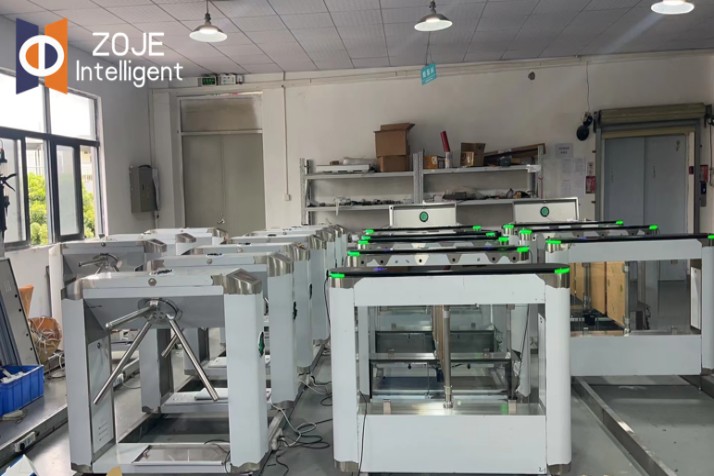
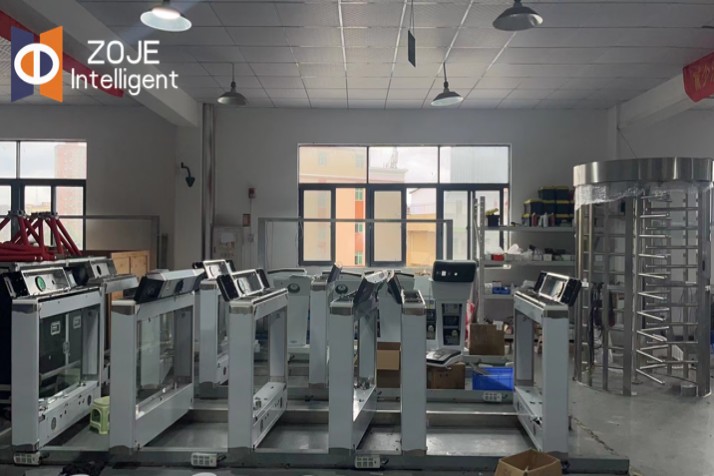
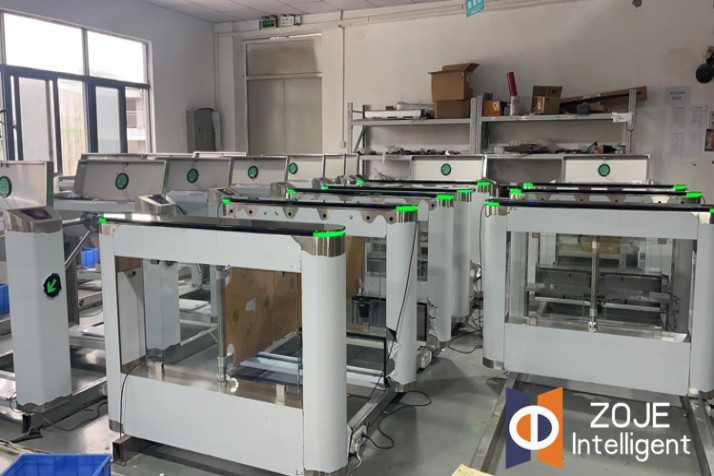
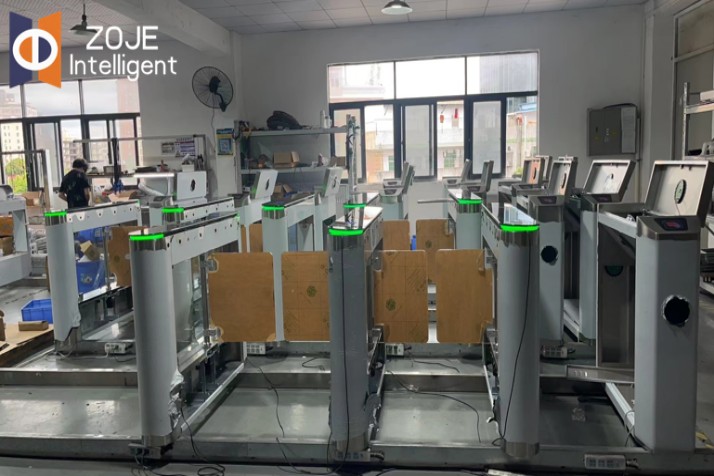
The factory photographs were taken before final testing. They show completed cabinets with powered indicators and several upper covers left open. Protective board remains on some barrier panels while technicians work around the equipment.
Different gate designs for different entrances
A Swing turnstile uses a moving panel to open or close a pedestrian lane. Compared with a traditional rotating-arm gate, it gives the entrance a more open appearance and offers greater flexibility in lane width. A standard lane can serve employees or visitors, while a wider lane can accommodate wheelchair users, passengers with luggage, delivery trolleys or families with pushchairs.
The Swing turnstile is therefore used in offices, residential communities, schools, hospitals and transport facilities. The units in this batch have light-colored cabinets, stainless-steel trim, glass sections and visible direction indicators.
A Tripod turnstile takes a different approach. Three stainless-steel arms rotate around a central mechanism, normally releasing one passage after an authorized signal. Once a person passes, the next arm returns to the blocking position. This structure is compact, familiar to users and suitable for entrances where one-person control is required without taking up too much floor space.
Factories, construction sites, gyms, parks and staff entrances often select a Tripod turnstile. It may be configured for entry, exit or bidirectional control, depending on the project.
What production completion means
Production completion involves more than fitting the outer cabinet. The mechanical parts, controller, power supply, indicator modules, wiring and ordered interface components must be installed in the correct unit. For ZOJE, keeping the cabinets identifiable during assembly is especially important when two product types are being prepared in the same batch.
Each Swing turnstile must correspond with the correct barrier panel, drive mechanism, lane direction and control setting. The glass needs to remain aligned with the cabinet, and there must be enough clearance for its full movement. Protective material stays on vulnerable areas until the technicians are ready to inspect and clean the finished surface.
The internal arrangement of a Tripod turnstile requires separate checks. Its rotating hub, locking parts and arms must work together without unwanted movement. Cable routing and terminal connections are reviewed before the covers are closed.
The open covers give technicians access to control boards and connections. After testing, cables will be secured, covers fitted and cabinet surfaces checked again.
Testing before overseas shipment
The upcoming test is intended to confirm how every gate behaves as a complete unit. A single successful opening is not enough. ZOJE will operate the equipment repeatedly and check whether the response remains stable from one cycle to the next.
For a Swing turnstile, the team checks the opening direction, movement of the panel, stopping position, closing action and passage indicators. The panel should move without touching the cabinet or producing unusual vibration. Where safety sensors are included, their response is checked as a person enters and leaves the detection area. The gate must also respond correctly to the input signal specified for the project.
Testing a Tripod turnstile focuses on the release, rotation and locking sequence. One valid command should permit the expected passage, after which the mechanism should return to a stable blocking position. The technicians also check direction control and any power-off or emergency function included in the order. If an adjustment is needed, it can be completed before packing rather than during overseas installation.
Appearance inspection takes place alongside functional testing. Painted sections, stainless-steel edges, glass panels, indicator lamps, covers and connection openings are checked for visible damage or poor fitting. ZOJE also confirms the accessories supplied with each unit so that mounting parts and related items are not separated from the correct lane during packing.
Connection with access control systems
Both products can receive commands from card readers, QR scanners, biometric terminals, ticketing systems or external controllers. The gate manages the physical passage after authorization.
A Swing turnstile may be chosen for a reception area using face recognition, for example, while a Tripod turnstile may operate with employee cards at a factory entrance. The identification method can differ, but the basic communication requirement remains important. Input signals, opening direction and lane numbering must match the installation plan.
ZOJE checks the agreed interface and operating logic before shipment. Final software commissioning takes place on site, but the factory test confirms that the gate receives the required signal.
Selecting the appropriate model
The decision between a Swing turnstile and a Tripod turnstile should begin with the people who will use the entrance. Lane width, expected traffic, accessibility, available floor space, security level and project budget all affect the choice.
The swing design is generally better suited to wider passage and entrances that require a cleaner architectural appearance. The tripod design is compact and provides a clear one-person release sequence. Some projects combine both: standard lanes use rotating arms, while a wider adjacent lane serves visitors, luggage, deliveries or wheelchair users.
In other words, the Swing turnstile addresses width and accessibility, while the Tripod Turnstile provides compact, orderly passage control.
In both cases, the gate provides the physical boundary while the reader or management system makes the access decision.
Final preparation for delivery
After testing, the cabinets will be closed and cleaned. The glass and exposed corners of each Swing turnstile will receive suitable protection, while the arms and mechanism parts of each Tripod turnstile will be secured for transport. Accessories will be checked against the packing list before the cases are closed.
This batch reflects the normal process followed by ZOJE before overseas delivery: production, functional testing, final inspection and packing. Completing these steps at the factory reduces avoidable work at the destination and gives the installation team a clearer starting point. Once the test results are confirmed, the equipment will be prepared for shipment and the project will move to its next stage.