ZOJE Semi-Automatic Hydraulic Bollard for Flexible Vehicle Access Control
Vehicle access does not always require a motor, a control cabinet, or a complicated management platform. At many private entrances, service roads, warehouse yards, and reserved parking areas, the lane only needs to open from time to time. For these locations, ZOJE offers a semi-automatic Hydraulic bollard that combines a visible physical barrier with a straightforward key-operated structure. An authorized person can close the route when protection is required and reopen it when approved vehicles need to pass.
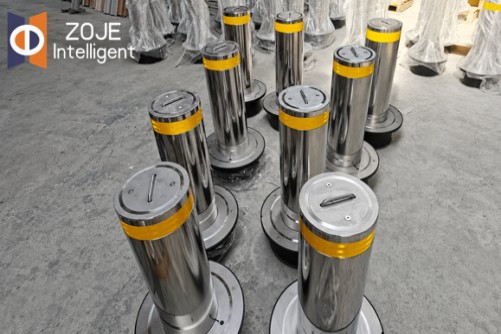
The product shown in our factory materials has a cylindrical stainless-steel body, a wide ground sleeve, a top lifting handle, and a yellow reflective band around the upper section. The clean metal finish gives it a simple appearance that fits commercial and industrial surroundings. More importantly, the reflective strip helps drivers notice the post in poor light or bad weather. A Hydraulic bollard should be easy to see before it becomes an obstacle, so this small detail has a practical purpose in daily use.
This model uses 304 stainless steel, and the specification lists a 6 mm stainless-steel plate. The post has a diameter of 219 mm and an above-ground height of 1,100 mm after installation. These dimensions create a substantial visual boundary at a driveway or restricted entrance. Compared with a narrower 168 mm post, the 219 mm body has a heavier presence and is harder for an approaching driver to overlook. Our team can use these size differences to help customers choose a suitable product for the scale of their site.
Although the product is described as semi-automatic, its operation is deliberately simple. The user inserts the key and unlocks the mechanism, holds the handle on the top cover, and lifts the post out of the embedded sleeve by hand. Once the vehicle has passed, the operator places the post back into the sleeve and locks it again. The Hydraulic bollard does not rise or lower through an electric motor. Access remains under the control of the person who holds the key.
This distinction is important for project planning. In some markets, buyers use “Hydraulic bollard” as a general search phrase for rising, retractable, or removable vehicle barriers. The model presented here does not rely on a powered hydraulic pump. It is a manually removable post with a key-operated lock. ZOJE states the operating method clearly so that buyers do not order a manual product when their project actually requires automatic movement, remote control, or frequent opening throughout the day.
The absence of electrical equipment can be an advantage. There is no basic requirement for power cabling, a control board, a card reader, a remote handset, a loop detector, or a network connection. This can simplify work at an entrance where electrical installation would be inconvenient or unnecessarily expensive. A Hydraulic bollard of this kind can also remain usable during a power failure because opening and closing depend on the key and the operator rather than an external power source.
According to the supplied specification, the product has an IP68 protection classification and an indicated working temperature range from -25°C to +75°C. These figures support its use in demanding outdoor environments, but they do not remove the need for correct installation. Drainage, foundation strength, sleeve alignment, local soil conditions, and the finished ground level all influence long-term performance. ZOJE recommends assessing the site carefully before excavation begins, especially in locations exposed to heavy rain or standing water.
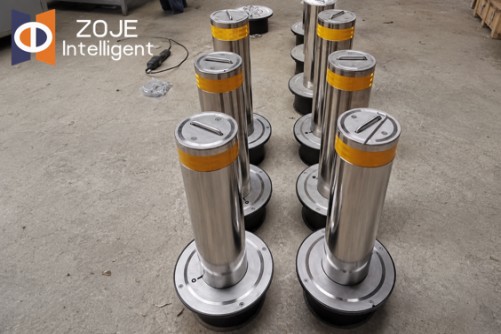
The embedded sleeve deserves particular attention. It should be installed vertically so the post can be removed and returned without scraping or binding. The surrounding foundation must hold the sleeve securely, while the top edge should meet the finished surface at the correct level. When the post is removed, the open lane should not contain an unexpected raised edge. Dirt, stones, leaves, and other debris should also be cleared regularly. Even a mechanically simple Hydraulic bollard works better when the below-ground section is kept clean.
Typical applications include private driveways, residential compounds, warehouse entrances, pedestrian streets, school service routes, commercial properties, reserved parking spaces, and internal roads. At these sites, the post may remain locked for most of the day and be removed only for deliveries, maintenance vehicles, emergency access, or authorized staff. The Hydraulic bollard creates a clear restriction without requiring a security guard to stand beside the lane continuously.
Key management is part of the security arrangement. The site owner should decide who may unlock the post, where spare keys will be stored, and what procedure will be followed if a key is lost. When the post is temporarily removed, it should be placed in a safe position where it cannot roll, block a pedestrian route, or damage nearby vehicles. ZOJE also recommends returning and locking the post as soon as the authorized vehicle movement is complete.
Routine inspection is not difficult. The user can check the stainless-steel surface, reflective band, top handle, lock, fasteners, and fit between the post and sleeve. The locking area should remain free from sand and other contamination, and the drainage condition should be reviewed after severe weather. If the post becomes difficult to lift or return, the operator should first inspect the sleeve for debris or misalignment rather than forcing the unit. This basic care can help a Hydraulic bollard remain convenient to operate.
The expected traffic pattern should guide product selection. A main entrance that opens many times each hour may be better served by an automatic rising bollard or a barrier gate integrated with access-control equipment. A lane that opens only a few times each day may not need that level of automation. The key-operated Hydraulic bollard is most suitable when occasional access, visible restriction, simple maintenance, and independence from electrical power are the main priorities.
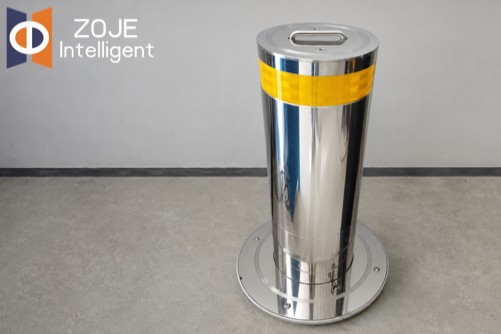
Before a product leaves our facility, our team checks the stainless-steel finish, yellow reflective band, lifting handle, key-operated lock, ground sleeve, and general fit of the removable sections. ZOJE also confirms the specified diameter, above-ground height, material, and supplied components. These checks are intended to make installation more predictable and to ensure that the customer receives a complete access-control product rather than only a metal post.
For ZOJE, a useful vehicle barrier should match the way a site actually operates. More automation is not always better, particularly when a route changes between open and closed only occasionally. This semi-automatic Hydraulic bollard offers a durable stainless-steel body, manual key control, clear visibility, and a removable design in one straightforward system. With proper civil work, responsible key control, and regular cleaning, it can provide a practical boundary for many low-frequency vehicle entrances.