Why Do Construction Sites and Scenic Areas Keep Choosing the Tripod Turnstile?
Walk into almost any construction site, scenic area, or gym in the world, and you will probably see the same thing at the entrance: three metal arms rotating around a central shaft, letting one person through at a time. The tripod turnstile has been around for decades, and it has not changed much in its basic form because the basic form works. At ZOJE, we have been building these gates for long enough to know that what looks simple on the surface is actually the result of a lot of engineering underneath. This is why it remains our best-selling access control product, year after year.
The first thing people notice about our bridge tripod turnstile is that it does not look like most other gates on the market. A standard installation requires two cabinets — one on each side of the passage — with the arms rotating between them. That means two motors, two control boards, two sets of wiring, and twice the floor space. Our bridge design puts everything inside a single cabinet that spans the passage, with arms extending from both sides. One unit creates a complete bidirectional pedestrian channel.
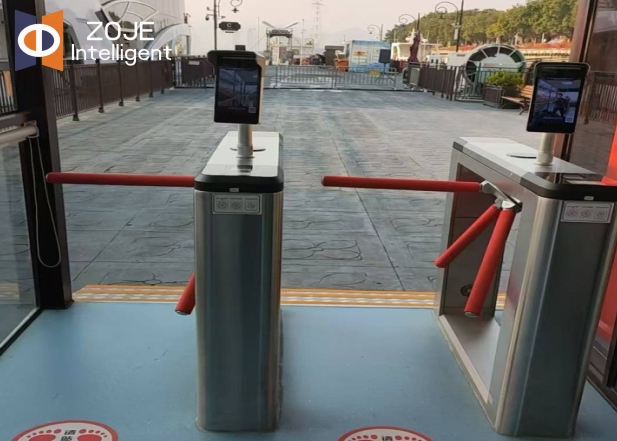
That single change has a ripple effect on everything else. It cuts the material cost roughly in half, the installation time in half, and the maintenance burden in half, because there is only one motor and one control board to service. It also cuts the footprint, which matters when the entrance is narrow or the site has limited space. For a project manager working on a tight budget, those savings add up quickly.
The cabinet is 1200 millimeters long, 280 millimeters wide, and 1000 millimeters high, with a channel width of up to 500 millimeters — enough room for a person to walk through comfortably, but not so much that two people can squeeze through side by side. The body is made of 1.5-millimeter brushed 304 stainless steel as standard, with 316 stainless steel available for coastal or industrial environments where corrosion is a real concern.
A lot of access control products are designed for clean, climate-controlled lobbies and then marketed as suitable for outdoor use. We do not do that. The ZOJE-S406 is built from the ground up for both indoor and outdoor installation. Brushed stainless steel does not rust, does not need painting, and cleans easily with a damp cloth. After five years outside in rain and sun, it still looks essentially the same as the day it was installed, aside from some normal wear on the rotating arms.
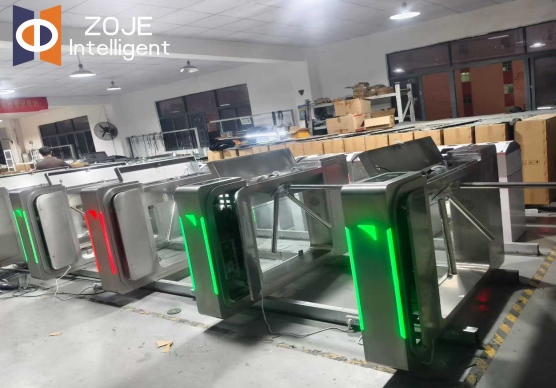
The unit operates across a wide temperature range and handles relative humidity up to 95 percent without condensation. That means it will work on a construction site in winter, at a scenic area in summer, and in a humid gym locker room without any special enclosure or heating kit. ZOJE gets asked about durability more than almost any other specification, and the answer is simple: this gate has so few moving parts — a motor, a rotating shaft, and three arms — that there is very little to break. No glass wings to crack, no belts to stretch, no complex linkages to adjust. The pass speed is 35 people per minute, which is more than enough for a medium-traffic entrance.If you have ever used an older tripod turnstile, you know the sound: a sharp metal clunk every time someone passes through, and arms that jerk into position with enough force to make you flinch. That noise comes from a basic solenoid mechanism with no damping. Our unit uses an HDY hydraulic buffer device that slows the arm's motion at the end of each rotation, so it comes to a stop smoothly instead of slamming into the housing.
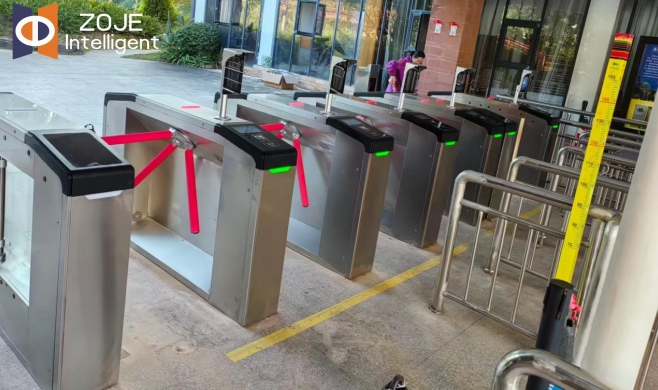
The result is a gate that runs quietly — quiet enough for a library or a museum — and that does not rattle the cabinet every time someone walks through. It also extends the service life of the mechanism, because there is no repeated impact stress on the shaft and the housing. For a site that runs 35 people a minute through the gate all day, that difference in mechanical stress adds up to years of additional service life.
The unit also has an automatic reset and anti-tailing function. After each person passes through, the arms rotate back to the locked position automatically, so the next person cannot follow immediately without presenting a valid credential. At a scenic area, for example, each visitor scans a ticket, the arms rotate once, and then they lock. The person behind cannot slip through without a ticket of their own. This is one of the reasons the tripod turnstile works so well for ticketing environments.
Safety is not an optional feature on an access gate. In an emergency, people need to be able to exit quickly, without waiting for someone to unlock a gate. Our tripod turnstile has a power-off drop arm function: when the electricity cuts out, the arms automatically drop down to a horizontal position, creating a clear passage that anyone can walk through without resistance. This is a requirement in most building codes and fire safety regulations, and it is one of the first things an inspector will check on a site visit.
The drop arm mechanism is purely mechanical — it does not rely on a battery backup or a software command. When the power goes out, gravity and a spring mechanism do the work. When the power comes back on, the arms reset automatically. The unit also has a built-in traffic indicator with red and green LED arrows, so people approaching the gate can see at a glance whether the passage is open or closed.
A tripod turnstile that only works with one brand of access controller is a problem. On a real project, the installer might be using RFID cards on one gate, fingerprint readers on another, and QR code scanners on a third. Our unit connects to all of them through a standard dry-contact and relay input interface, so it works with ID cards, IC cards, EM cards, fingerprint scanners, face recognition terminals, QR code readers, and ESD testing systems.
The communication interface supports RS485 and TCP/IP, so the gate can connect to a central access control management platform and report every entry and exit event in real time. For sites that do not need central management, it can also operate standalone with a local whitelist. ZOJE also offers a fully automatic drive option with brush, brushless, or servo motors for projects that need faster operation; the standard semi-automatic solenoid drive is the right choice for most medium-traffic sites, because it is simpler, cheaper, and more reliable.
The tripod turnstile is designed for medium-security environments where the goal is to control and count access, not to create an impenetrable physical barrier. For high-security sites such as prisons or data centers, a full-height turnstile is the better choice. But for the vast majority of applications, it hits the sweet spot between security, cost, and practicality.
Construction sites are one of the largest application areas — hundreds of workers coming and going every day, and the site manager needs to know who is on site at any given time. Scenic areas use it as part of the ticketing system, where the anti-tailing function ensures that one ticket equals one entry. Gyms, swimming pools, and sports facilities use the same setup for member access. We have also installed these units at factory entrances, office buildings, schools, hospitals, and public transportation hubs. The common thread is reliable, cost-effective access control without the complexity of a high-security system.
Not every installation site is a clean, flat, standard-width entrance. Some have narrow corridors, low ceilings, or unusual floor conditions. At ZOJE, we customize the product to fit the site — adjusting cabinet dimensions, channel width, arm length, mounting configuration, exterior finish, and branding as needed. This capability is one of the reasons our distributors keep coming back.
Every unit that leaves the ZOJE factory goes through a continuous run test before it is packed — hundreds of cycles, motor temperature checks, anti-tailing verification, and emergency drop arm confirmation. The product carries a two-year warranty as standard, and we keep spare parts in stock for units that are years out of warranty.
If you are working on an access control project and trying to decide between a high-end speed gate and a basic manual gate, the tripod turnstile is almost certainly the middle ground you are looking for. It is secure enough for most applications, affordable enough for most budgets, and durable enough to last for years with minimal maintenance. At ZOJE, our sales team can help you configure the right unit for your specific site, and we can provide samples for evaluation before you place a larger order.