Speed Turnstiles for Airports: How Double-Door Interlocking Stops Tailgating
A single-door turnstile at an airport checkpoint verifies one credential and opens one gap. What happens in the two seconds after that gap opens is where the security problem lives. One passenger taps a valid card or pass, the barrier swings, and a second person walks through behind without ever presenting anything. In a terminal, that gap is not a minor inconvenience. It is the difference between a controlled area and an uncontrolled one.
That is why airport security planning has moved toward the speed turnstile with two interlocked doors instead of one. The logic is simple to state and harder to engineer: Gate A opens only after verification, Gate B stays locked while A is open, and B opens only after the person has entered the space between them and A has closed again. If a second person follows into that space, the sensors detect two bodies, the system raises an alarm, and Gate B refuses to open until the trailing person backs out. Physical separation does what a single barrier cannot, and that separation is the whole point of the speed turnstile.
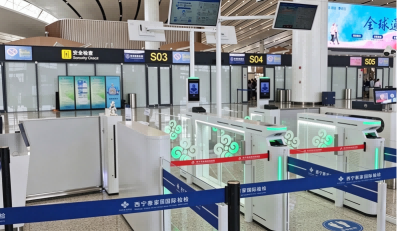
The principle behind the layout is a closed loop of entry, verification, release, and lock. Three rules govern it. ZOJE builds the lane so those three rules hold in hardware, not just in software. The two doors of the speed turnstile interlock, so one is always closed while the other is open, which removes the tailgating window at the physical level. Verification is multimodal, so the credential and the person are checked together rather than separately. And abnormal events trigger a response, so a tailgater, a climber, or a forced entry sets off an alarm and locks the lane while the security system is notified.
The speed turnstile used in this role is a different product from the lobby gate. ZOJE builds the BST800 around a pair of swing doors inside a single lane, with infrared sensors covering the space between them. The cabinet runs 2950 millimeters long by 160 wide and 1000 high in the standard configuration, the passage is 600 millimeters wide with a 900-millimeter option for passengers with luggage or reduced mobility, and the unlock time is 0.2 seconds with a throughput of 35 to 40 people per minute. The material is 304 stainless steel, with 316 available for coastal or corrosive sites, and the door panels are acrylic or tempered glass.
Verification is where the airport requirement diverges from an office building. A standard lane accepts IC, ID, and RFID cards, QR codes, fingerprints, face recognition, and iris recognition. The BST800 also supports passport recognition, which matters at a border or customs lane, and the reader mix can combine a document reader, a face terminal, and a boarding pass scanner so that the credential, the person, and the flight record are checked in one step. ZOJE builds the lane around a unified external interface, so the verification devices follow the project rather than being fixed at the factory. The speed turnstile accepts the reader combination the lane requires, and the combination is confirmed before the order is placed.
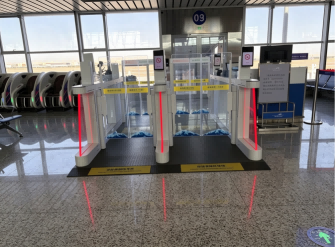
The control layer ties the hardware together. An interlock controller keeps the two doors synchronized in real time and holds the fail-safe behavior that opens both gates when power is lost. Personnel permissions are set by group: crew may pass around the clock, passengers only within their flight window, contractors only for the hours on their work order. Every passage is logged with the time, the credential, and the result, and every abnormal event generates a record that can be reviewed later. ZOJE configures the speed turnstile to report through RS485 or TCP/IP, which lets the airport connect it to its existing security platform instead of running a separate system.
Alarms operate on several levels. A local sound and light alarm fires at the lane when a tailgater is detected or a failed verification is followed by a forced push. The same event is pushed to the security command center with the lane location, and where the monitoring system allows it, the camera feed for that lane comes up alongside the alert. In an emergency such as a fire or an earthquake, the control system switches to evacuation mode and unlocks both doors at once, so the lane becomes a free exit rather than an obstacle.
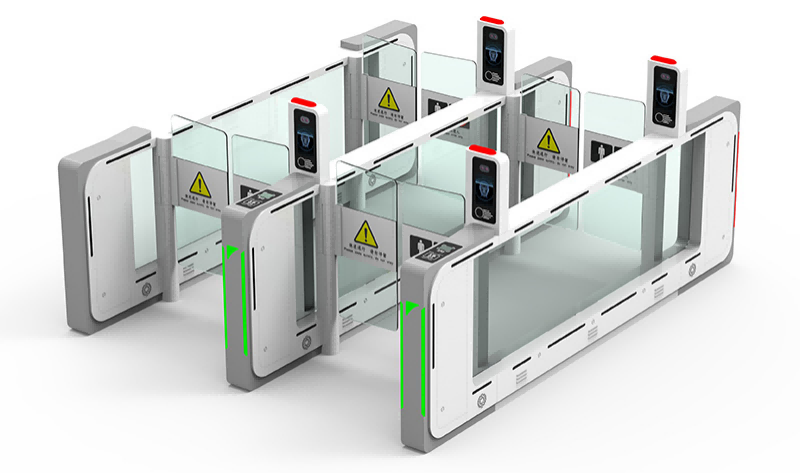
Implementation follows the same sequence in most airport projects. The site survey fixes the lane position, and the position has to leave enough queue space before the checkpoint and sit close to the monitoring points that cover it. The lane count follows the traffic: one AB lane with two verification terminals is the usual unit per channel, with temporary lanes added for peak periods. The data interface is agreed with the airport's information team before installation, because the verification terminal has to talk to the flight system and the security system, not just to the gate.
Installation itself is ordinary work done to an exact standard. The lane is anchored with expansion bolts, leveled, and set with a floor gap under 5 millimeters. Verification terminals go at 1.2 to 1.5 meters above the floor, clear of backlight and obstructions. High-voltage supply and low-voltage signal wiring run in separate conduits so the readers are not disturbed by interference. Commissioning the speed turnstile then tests the interlock logic first, follows with a set of abnormal scenarios that includes tailgating, proxy verification, and forced entry, checks that alarms reach the command center and the camera feed follows, and finishes with a stress run at 50 people per minute to confirm the lane holds its timing under load. ZOJE ships each lane with the anchor template and wiring diagram, which keeps the site work inside the standard schedule.
The case for the speed turnstile in this configuration rests on three gains that pull in the same direction. Security improves because tailgating is blocked by the door sequence rather than by a guard's attention, and identity is checked against the person rather than the card alone. Throughput improves because the verification step takes a fraction of a second and the lane does not need an officer at each passage. Management improves because the system produces a record of who passed, when, and with what result, and because permissions can be set by group instead of by individual exception. ZOJE supplies the lane with the interlock logic and the permission structure configured for the site, so the airport starts from a working baseline rather than a blank controller.
Airport security requirements have tightened every year, and the double-door interlocked lane has become the standard answer at checkpoints, transfer corridors, crew entrances, and controlled-area gates. ZOJE supplies the speed turnstile, the verification integration, and the control layer as one package, with the lane dimensions, the door material, and the reader set confirmed against the project before shipment.