How Does a Tripod Turnstile Gate Handle Holiday Crowds at a Scenic Area
A scenic area sells a ticket, and then it has to prove that every visitor bought one. That proof is collected at the entrance, in the seconds between one visitor presenting a credential and the next one stepping forward. When the entrance runs on manual checking, those seconds are where the losses start: a gate waved through without a scan, a family of four passing on one ticket, a queue that stretches past the car park on the first day of a holiday. The tripod turnstile gate is the piece of hardware that closes most of that gap, and in the last few years it has become the standard entrance device for scenic areas, theme parks, and cultural tourism complexes.
The problems with manual ticketing are consistent across sites, large and small. Staff check tickets by eye, and the error rate rises with the queue. Peak days concentrate tens of thousands of arrivals into a few hours, and the entrance becomes the bottleneck rather than the attraction. Tailgating and shared tickets cost revenue directly, and the loss is hard to measure because nobody counts the visitors who walked through behind someone else. Labor cost rises every year, and the staff needed on a holiday weekend is several times the weekday level. A scenic area that wants to grow its visitor numbers has to solve the entrance before it can handle the traffic.
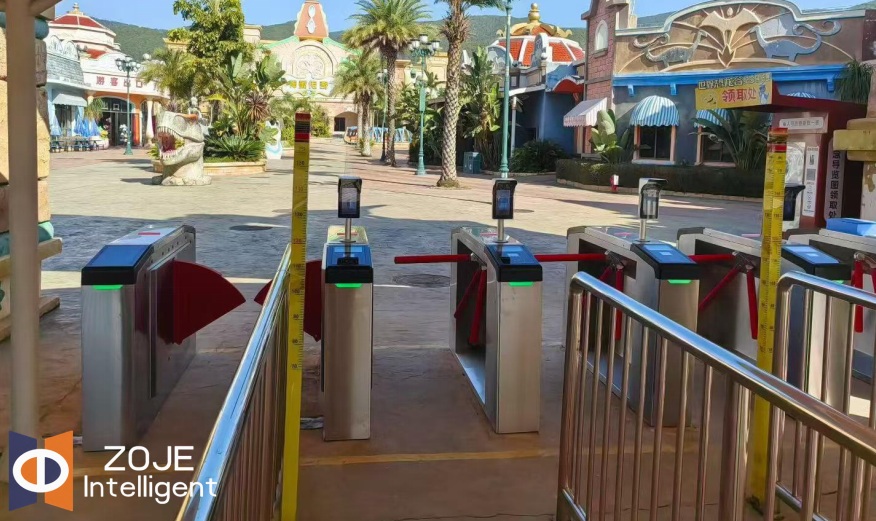
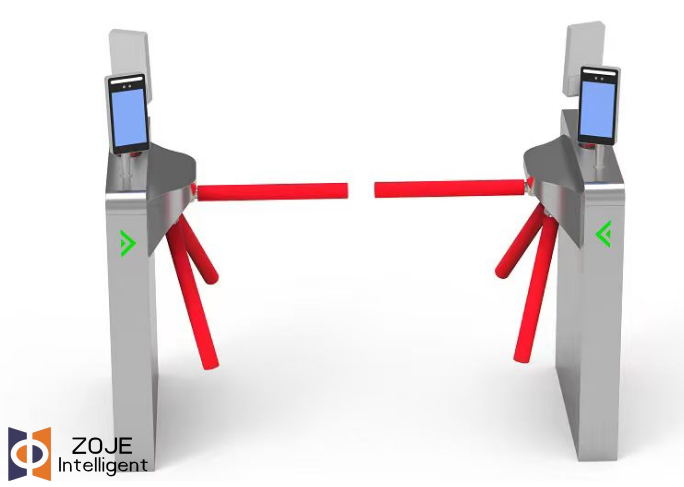
A tripod turnstile gate addresses the flow problem with a mechanical answer that no software alone can provide. The three rotating arms allow one person to pass per rotation, so the lane physically enforces one ticket, one entry. A second person cannot walk through behind the first without contacting the arms, and the collision is detected, so the gate stops and the attempt is recorded. Industrial-grade full-automatic anti-collision mechanisms are the specification for outdoor scenic use, because the arm has to survive a visitor pushing against it, a child hanging on it, and a bag dragged through the gap without bending or jamming. ZOJE builds the mechanism around a self-developed movement with an integrated shaft, clutch, reducer, motor, and encoder, which keeps the transmission concentric and extends the service interval on a lane that runs all day.
The verification side has changed more than the mechanical side. A modern tripod turnstile gate integrates a QR code scanner, a face recognition terminal, and an ID card reader on the same lane, and the choice of reader follows the ticket policy of the site. A scenic area that sells through its own system can issue a QR code that the scanner validates in under a second. A site that wants registered visitors can use face recognition against a photo captured at the ticket window. A site that issues physical cards for tour groups can read the card and record the group. ZOJE builds the lane with a unified external interface, so the terminals can be combined and later changed without replacing the gate.
The value of that integration shows up in the ticketing workflow. A tripod turnstile gate connected to the ticketing system validates the credential against the booking record in real time, which means a ticket sold through an online channel, a mini program, or an OTA platform is recognized at the gate without a separate check-in step. The gate reports the validation back to the system, the booking is marked as used, and the visitor walks through in a second or two. For the operator, the whole channel becomes one inventory instead of several, and the reconciliation that used to take a morning now happens continuously. ZOJE confirms the ticketing interface with the site's software provider before delivery, so the validation logic matches the way that site actually sells.
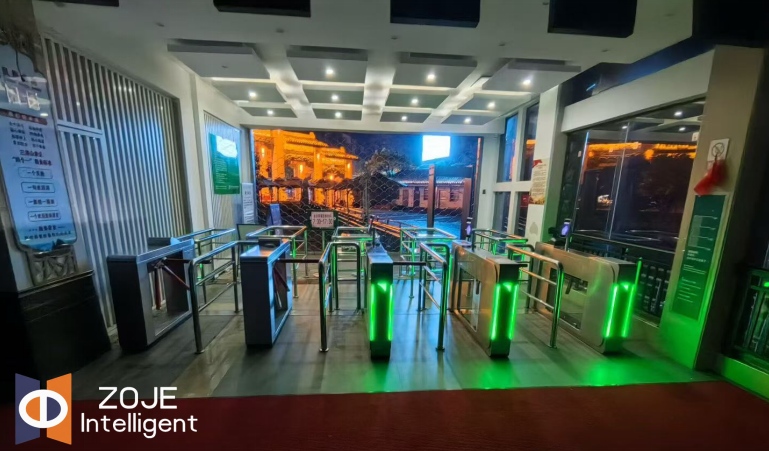
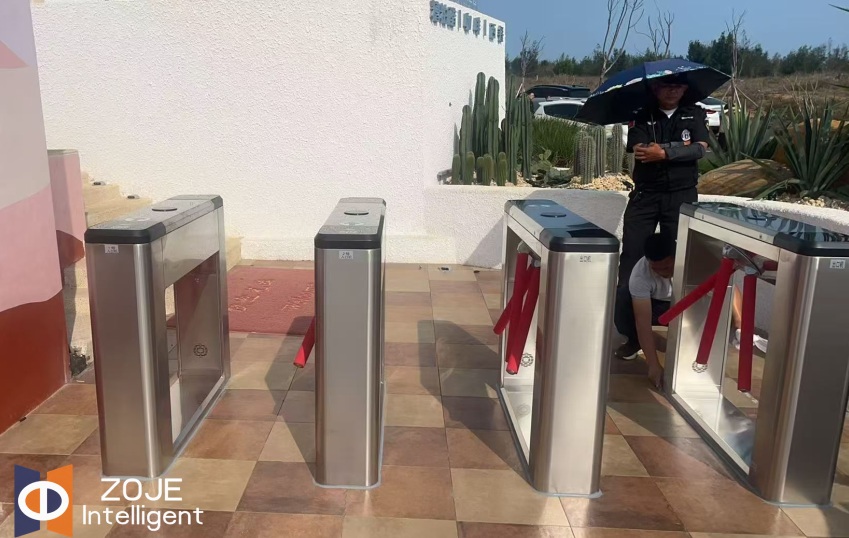
Outdoor conditions are the part of the specification that indoor vendors tend to underestimate. A scenic entrance sits in sun, rain, snow, dust, and salt air, and the gate has to work through all of it for years. The tripod turnstile gate specified for these sites carries an IP65 rating for dust and water protection, a stainless steel cabinet, and a mechanism designed for high-frequency use across a 24-hour cycle. Temperature range, humidity, and corrosion protection are part of the selection, and ZOJE configures the cabinet material and the surface treatment for the climate the site actually has rather than shipping one specification to every region.
Power and network failures are handled as normal operating conditions rather than exceptions. A tripod turnstile gate with a fail-safe design drops its arms automatically when the power fails, so the lane becomes a free exit during an evacuation instead of a blockage. When the network drops, the lane can continue to validate locally cached credentials and store the passage records, then sync them when the connection returns. For a site with a generator that takes a minute to start, or a mountain area with an unstable link, those two behaviors decide whether the entrance keeps moving.
The system around the gate is what turns passages into management information. A complete installation combines the tripod turnstile gate, the verification terminals, and a cloud management platform that records every passage, counts arrivals by hour, and shows the flow by lane and by zone. The operator can see the peak window before it arrives, move staff to the lane that is filling, and compare this holiday with the last one on the same chart. ZOJE supplies the platform with the gate, and the data is available to the ticketing team and the operations team from the same source.
Installation is lighter than most operators expect. The tripod turnstile gate arrives as a self-contained lane, anchors to a prepared base, and connects to power and network through standard interfaces. A scenic area upgrading an old entrance can keep the existing walkway and replace the gates over a few nights, without rebuilding the plaza. A new site can plan the lanes into the entrance design from the start, with the lane count set by the peak arrival rate rather than the average. ZOJE supplies the lane with the anchor layout and the wiring diagram, and the commissioning checklist covers the certification that the site's ticketing platform needs.
The direction of the market is toward fewer staff at the gate and more information behind it. Scenic areas in China moved first, driven by holiday volumes and the spread of online ticketing, and the pattern is now visible in overseas attractions that sell through booking platforms and expect visitors to arrive with a QR code on a phone. The tripod turnstile gate fits that model because it is mechanically simple, tolerant of weather, and inexpensive to maintain compared with a wide speed gate, which makes it the right choice for the high-volume, outdoor, cost-sensitive entrance that most scenic areas actually have.
For a scenic area planning an entrance upgrade, the tripod turnstile gate is the component that makes the rest of the system work: the ticket is validated once, the lane passes one person at a time, the record reaches the platform, and the entrance keeps running through weather and outages. ZOJE supplies the gate, the verification terminals, and the management platform as one package, with the lane count, the reader mix, and the climate specification agreed before production.