How Does an App-Managed Turnstile Gate Simplify Visitor Access
A turnstile gate used to be a piece of hardware that answered to whoever sat at the control desk. Cards were issued at the desk, visitors were written into a logbook, and any change to the access rules meant walking to the computer beside the lane. That arrangement assumed a person was always present, which is no longer true for many buildings. The turnstile gate has become a networked device, and the control desk has shrunk into a phone screen that a facility manager can open from anywhere.
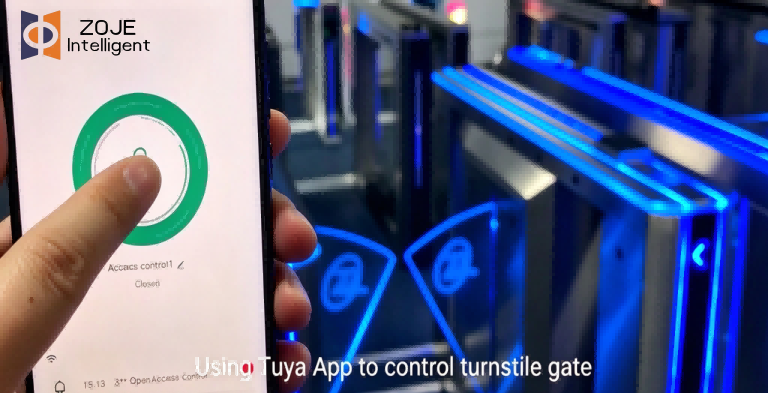
The old model had costs that rarely showed up in the budget. Every new employee needed a card, every lost card needed a replacement, and every contractor arriving after hours needed someone to walk over and press a button. Cards were shared between colleagues, copied, and lost in ways that made the access log unreliable. A building that ran three shifts needed three sets of people to manage the same lanes, and a building that ran no shifts at all, such as a coworking floor or a gym that opens early, had no way to handle visitors at all.
The change began with connectivity. Once a turnstile gate connects to the network through a standard interface, its state can be read and changed remotely. The functions that follow are simple but useful: the lane can be opened or closed from a phone, the passage records can be reviewed by time and by credential, and a temporary password can be created for a visitor who has no card and no registered face. ZOJE supplies gates with the communication interfaces that make these functions possible, including dry contact, RS485, and TCP/IP.
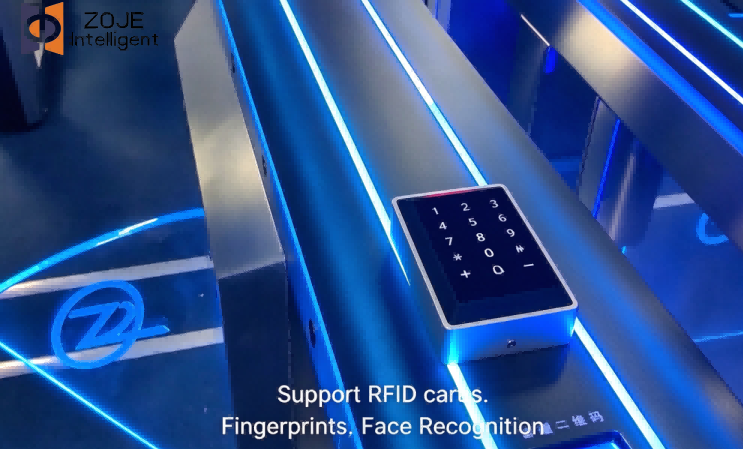
The temporary password is the feature that changes daily operations the most. A six-digit code is generated in the app, given an effective date and an expiry date, and set as either one-time or repeatable. The visitor types the code on the keypad mounted on the lane and walks through. Nothing is issued, nothing is collected, and nothing has to be returned at the end of the visit. When the expiry date passes, the code stops working on its own, which removes the follow-up call that used to end every contractor visit.
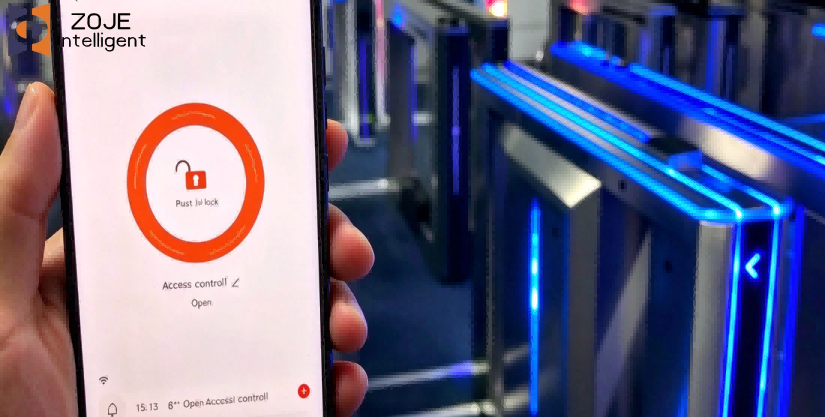
Buildings with a steady stream of non-employees feel this change most directly. A cleaner arrives twice a week. A technician comes to service the air conditioning. A courier needs to reach the mailroom. A short-term tenant moves in for a month. Under the card model, each of these people needs a card, and each card is a small piece of inventory that has to be tracked. Under the app model, each of them gets a code for the period they need, and the facility manager creates it in less than a minute.
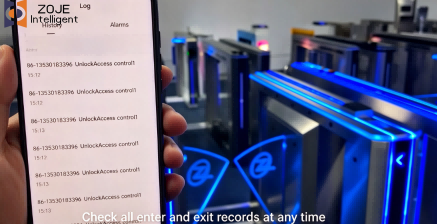
The records side is equally practical. Every passage through the turnstile gate is logged with the credential used and the time it happened, and the app shows both the history and the alarms in one place. If a lane is forced open or a reader fails, the alert appears rather than waiting for a guard to notice. For a manager responsible for several buildings, the ability to check the entry records of each site without visiting it is the difference between reactive and planned maintenance. ZOJE configures each lane to report passages and alarms through the same interface the app reads, so the log is consistent across sites.
Credential support has widened at the same time. A modern turnstile gate can carry an RFID reader, a fingerprint sensor, a face recognition terminal, a QR code scanner, or a numeric keypad, and a single lane can combine more than one. ZOJE builds the gates around a unified external interface, so the reader choice follows the project rather than the other way around. An office that already issues staff cards keeps using them, a gym that prefers face recognition adds the terminal, and a building that wants visitors on codes adds the keypad.
The applications that benefit most are the ones with irregular traffic. Coworking floors, serviced apartments, 24-hour gyms, university buildings, exhibition venues, and industrial parks all have people arriving who are not on a fixed roster. These operators do not want to staff a reception desk around the clock, and they do not want to hand out cards that may never come back. A turnstile gate managed through an app fits their model: the rules are set once, the exceptions are handled remotely, and the records accumulate without manual entry. ZOJE ships the gates with the keypad and reader options these operators need, and the reader mix is confirmed before the order is placed.
The trend is visible in both directions. In China, smart parks and office buildings have moved quickly from card-based access to app and cloud management, and the pandemic years accelerated the shift toward contactless credentials. In overseas markets, the demand comes from a different mix: short-term rentals, coworking spaces, and unmanned facilities that need remote control because there is nobody on site. Both markets are asking the same question, which is how to manage a turnstile gate without standing next to it. ZOJE builds for that question in both regions, with the software side left open to the platform the customer already uses.
ZOJE approaches the turnstile gate as a product plus an access layer. The gate provides the physical control, the sensors, and the safety functions; the access layer provides the readers, the communication, and the software connection. The company supports integration with third-party management platforms as well as the mobile tools that operators prefer, so a project is not locked into one ecosystem. Configuration is handled before shipment, and the reader mix, the credential types, and the communication protocol are confirmed with the customer at that stage.
For a facility manager, the value of the turnstile gate now includes what happens after installation: who can pass, for how long, and with what record. The hardware still has to be solid, and the safety functions still have to work, but the management side is where the daily saving sits. ZOJE supplies the gates with the access layer configured for the site, and the operator runs the lanes from a phone instead of a booth.