Speed, Silence, and Service Life: What to Look for in a Speed Gate
The entrance of a modern office building is a demanding place for any piece of equipment. Thousands of people pass through it every day, in all kinds of weather, at all hours. A gate that fails here does not just cause a queue — it forces security staff to step in manually, and it makes the building look bad in front of the people who use it daily. At ZOJE, we build the aluminum speed gate for exactly this kind of environment, and we design it around one simple principle: the moving parts should be the last thing that wears out. This article explains how we achieved that.
Every access gate has a motor that drives the doors, a clutch that engages and disengages the drive, a reducer that adjusts the speed and torque, and an encoder that tells the controller where the doors are. In a conventional design, these four components are separate units bolted together inside the cabinet. Each one has its own bearings, its own shaft, and its own alignment requirements. Over time, the alignment drifts, the bearings wear unevenly, and the whole assembly starts to rattle. The gate gets slower, noisier, and eventually fails.
This is the problem that most speed gate maintenance calls are about. The fix is usually a new clutch or a new reducer, and the replacement is expensive because the technician has to disassemble half the cabinet to reach it. We looked at this design and decided it was solving the wrong problem. Instead of making the individual components more durable, we eliminated the weaknesses that come from assembling them separately.
This speed gate uses a new-generation movement with an integrated design: the main shaft, clutch, reducer, motor, and encoder are all built into a single unit. This is not a packaging change. It is a mechanical change that affects how the gate behaves in three important ways.
First, integration improves concentricity. When five components share one housing, they stay aligned by design. There is no drift over time, because there is nothing to drift. The transmission runs true from the first day to the last, which means the doors open and close with the same precision after a year of use as they did on day one.
Second, integration reduces wear. In a separate-component design, the clutch and reducer take repeated impact every time the gate stops and starts. In our integrated unit, the transmission is tuned as one system, so the forces are distributed smoothly instead of hammering individual components. The result is what we call zero-wear operation in normal use, and it is the reason these units are rated for millions of cycles.
Third, integration makes maintenance simpler. When the movement is one unit, a technician can test it, adjust it, and replace it without touching anything else in the cabinet. The gate also has a built-in device and circuit testing function, so a fault can be diagnosed from the control board in minutes rather than by trial and error.
The movement runs on the latest second-generation ARM control technology, which keeps the gate responsive, easy to expand, and cost-effective to produce. The control system adjusts the door speed smoothly, so the gate can be tuned to open fast for rush hour and close gently to avoid startling people.
A speed gate is defined by its speed, and the numbers here are straightforward. The ZOJE-BST600 unlocks in 0.2 seconds and handles 35 to 40 people per minute per channel. That is fast enough to keep a line moving during peak hours in a busy lobby, and it is achieved without the loud clunk that older gates produce. The integrated transmission and the servo control work together to make the doors accelerate and decelerate smoothly, and the unit runs at low noise and low power consumption.
We have measured the difference against earlier designs at ZOJE's test lab. The old mechanism spent its energy in mechanical impacts that you could hear across the lobby. The new one spends its energy moving the doors, and what is left over is a quiet hum that fades into the background. For a bank branch or a corporate headquarters, where the entrance is part of the customer experience, that difference is worth a lot.
The cabinet is 1400 millimeters long, 146 to 203 millimeters wide, and 1000 millimeters high, made of brushed 304 stainless steel as standard with 316 stainless steel available for coastal environments. The door wings are acrylic as standard, with tempered glass available for a more premium look. The unit operates across a wide temperature range and handles relative humidity up to 95 percent without condensation, so it works both indoors and outdoors.
The standard channel width is 600 millimeters, which suits most office and bank applications. For projects that need to accommodate wheelchairs, luggage, or trolleys, we offer a 900-millimeter wide channel as an option, and the passage width can be customized further. The height of the swing doors can also be adjusted to match the design of the building.
This flexibility matters more than most buyers realize. A speed gate is often the first thing visitors see when they enter a building, and it needs to fit the space and the look of the lobby. Being able to adjust the channel width, door height, and finish means the gate can be made to suit the project instead of the project being forced to suit the gate.
A gate that opens quickly also has to stop safely, and this is where many fast gates fall short. Our unit has high-sensitivity optical sensors that detect when a person is in the channel. If someone is standing in the path while the doors are closing, the sensors trigger an immediate stop and reversal. A mechanical anti-pinch function provides a second layer of protection, so even if the sensors are blocked by a large object, the doors will not apply crushing force.
In an emergency, the gate switches to fail-safe mode: the doors open automatically and the channel becomes a clear passage for evacuation. This is a requirement in most building codes, and it is one of the first things a safety inspector checks. The gate also has automatic reset after each passage, and it shows a traffic indicator with red and green arrows so people can see whether the channel is open or closed.
This gate does not care what access control system the building already uses. It connects to IC cards, ID cards, RFID readers, QR code scanners, fingerprint scanners, face recognition terminals, iris recognition devices, and ESD testing systems through a standard dry-contact and relay input interface. Communication runs over RS485 or TCP/IP, so the gate reports every entry and exit event to a central management platform in real time.
For a bank, this integration is critical, because bank security systems are usually already installed and changing them is expensive. Our speed gate drops into the existing infrastructure and works with the readers that are already on the wall. For a new office building, the same flexibility means the developer can choose the access control brand they prefer without worrying about compatibility.
The modular structure of the unit also makes it easy to expand. If a building adds a new entrance later, the same gate model can be installed and connected to the same management platform without custom engineering.
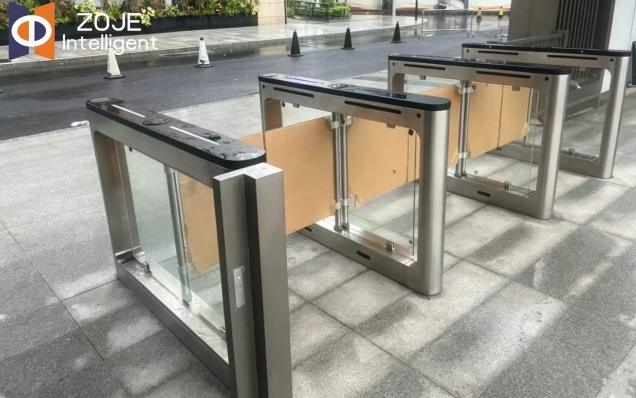
The aluminum speed gate is designed for places where appearance matters as much as throughput. Office buildings use it to manage employee access during the day and visitor access after hours, with face recognition terminals mounted on top. Banks use it to control access to the branch and the back office, where security requirements are strict but the entrance still needs to feel welcoming to customers.
ZOJE has also installed these units at government buildings, data centers, hotels, and corporate headquarters. The common thread is that these sites need a gate that moves people quickly, looks good doing it, and does not require constant maintenance. That is what the speed gate delivers.
At ZOJE, every speed gate that leaves our factory goes through a continuous run test before it is packed. We cycle the doors hundreds of times, check the sensor calibration, verify the fail-safe function, and confirm the communication interface. The product carries a two-year warranty as standard, and we keep spare parts in stock for units that are years out of warranty.
We also customize extensively. The channel width, door height, cabinet finish, and branding can all be adjusted for a specific project, and the gate can be supplied with the access control readers already mounted and wired. This is one of the reasons our distributors keep coming back — they know that if a project has unusual requirements, we will find a way to meet them.
If you are planning an office, bank, or institutional entrance and want a gate that will still be working ten years from now, the ZOJE-BST600 is worth evaluating. ZOJE's sales team can help you configure the right unit for your site, and we can provide samples for a trial installation before you commit to a full order.