How Speed Turnstile Gates Improve Office Building Access Control
Walk into a newly fitted office tower and the entrance hardware has changed from what it was five years ago. The swing gate with a wide acrylic wing and a visible hinge is being replaced by a slimmer unit with a narrow glass pane that slides open almost before the card is read. The difference is not just cosmetic. A swing gate moves a door through an arc, which takes longer and makes a mechanical noise with every cycle. A speed turnstile gate moves its glass panel in a short linear stroke, opens in under a second, and runs on a brushless motor that hums instead of clanking. On a floor that sees several hundred passes a day, that difference in sound and speed adds up.
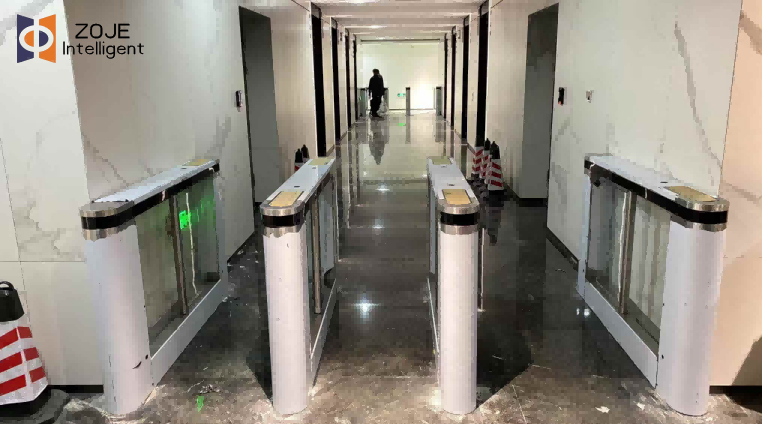
The BST500 is ZOJE's stainless steel speed turnstile gate for indoor projects that want the slimmer look without moving to an aluminum body. The cabinet is 1400 millimeters long and only 146 millimeters deep in the standard version, which leaves a wider walkway beside the lane and reads as lighter than a swing gate cabinet of similar height. The door is tempered glass as an option, with acrylic as standard, and the top carries a thin LED light strip that signals green or red. The whole unit stands 1000 millimeters high, which is low enough to keep sightlines open but tall enough that the door cannot simply be stepped over.
The drive is where the speed turnstile gate earns its name. A DC brushless motor drives the glass panel along a guided track, and the control board uses the second-generation ARM platform to time the opening and closing cycles. Unlock takes 0.2 seconds, and the panel opens just far enough to admit one person, then closes behind them. Throughput runs at 35 to 40 people per minute per lane, which is the same as a good swing gate, but the perceived speed is faster because there is no swinging arc to wait for. A person who taps a card and keeps walking does not have to pause for the door to swing out of the way.
The noise difference is the detail that people who work in the building notice first. A swing gate on a hinge makes a faint click and a swivel noise on every cycle, and over a morning rush that noise carries down a polished stone corridor. The brushless motor in the speed turnstile gate runs almost silently, and the glass panel moves on a cushioned track rather than a hinge. For a law firm, a technology office, or a financial services floor where people are on phone calls and in meetings, that low noise is not a luxury feature — it is part of why the entrance does not feel like a subway station.
The speed turnstile gate moves a glass panel at walking speed, so safety is handled the same way as on ZOJE's other indoor turnstiles. Three layers of anti-pinch — physical, infrared, and mechanical — stop the panel if it meets resistance. Intrusion alarm, tailgating alarm, anti-collision, anti-reverse, and wrong-way detection are on the control board. In a power failure, the panel opens automatically through a battery-backed fail-safe, which keeps the exit clear. The normally open mode lets the gates sit open during a fire drill or a staff event, and the normally closed mode locks them down when the building is empty. ZOJE sets the fail-safe to open the panels automatically on power loss.
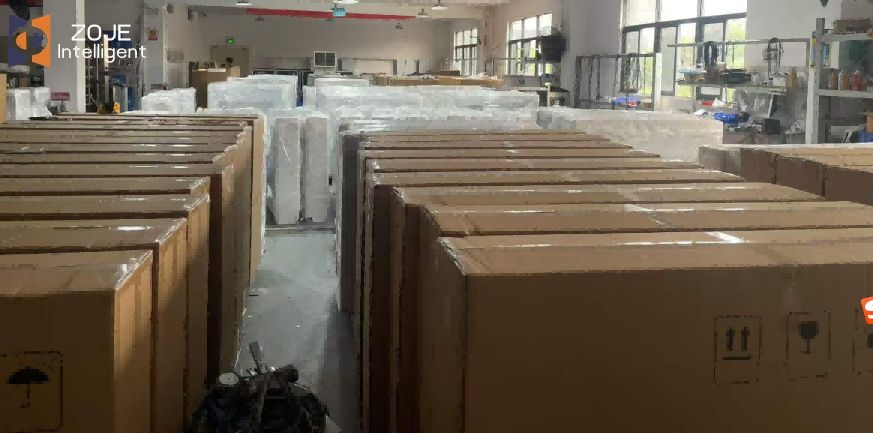
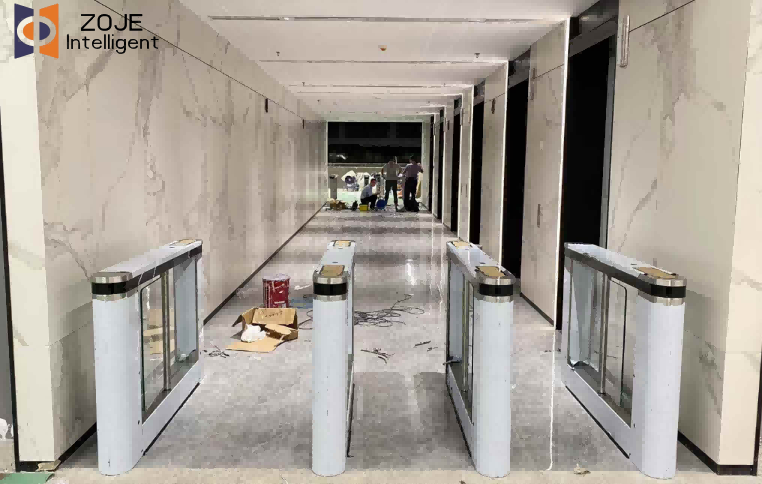
A 30-unit order of the speed turnstile gate is a multi-lane indoor installation in a commercial building corridor. The order was placed as a single batch, which means every cabinet comes off the same production run and carries the same finish. ZOJE packs each unit in a plywood crate for the move to site, and the installation crew positions the cabinets on the finished stone floor, bolts them down, and connects them to the building's access network. The project is at the installation stage now, with the units in place and the wiring being terminated before the readers and face terminals are mounted on top. ZOJE coordinates the installation timeline with the main contractor so the gates are ready before the building hands over to tenants.
Integration with the access system is the last step. The speed turnstile gate accepts IC and ID cards, RFID tags, QR code scanners, fingerprint readers, and face recognition terminals over a standard external interface, and it communicates over RS485 or TCP/IP. The building's security team can set the lanes to one-way in the morning and bidirectional in the afternoon, can log every passage, and can open all lanes remotely if a delivery needs to move through. The channel width is 600 millimeters as standard, and it can be widened to 1000 millimeters for wheelchair access or for a lane that also handles parcel trolleys.
The speed turnstile gate cabinet is brushed 304 stainless steel, with 316 available for coastal buildings, and the IP67 rating means the unit works in a covered outdoor canopy as well as inside a climate-controlled lobby. ZOJE builds the BST500 with an integrated movement design that reduces the number of wearing parts, and the MTBF rating is 10 million cycles. The unit ships with a two-year warranty, and spare parts are kept in stock for buildings that run their entrances all day.
For a new office building that wants a modern entrance without the bulk of a swing gate, the speed turnstile gate is the piece that fits. It is fast, quiet, slim, and it disappears into the corridor design rather than standing out from it. ZOJE supplies the BST500 as a standard model with options for tempered glass, a servo drive for higher-traffic sites, and a wider channel for accessible lanes.