Why Are Full Height Turnstiles Ideal for Construction Site Security
A shipment of 200 units is being prepared at the ZOJE workshop, all of the same model, all bound for a construction project in Australia. The order is not for an office lobby or a metro station. It is for a work site where the gates will stand in the open air, where they will be hit by dust, rain, and the occasional temperature swing, and where no security guard will be standing next to them during the night shift. The product chosen for that duty is the Z2001 full-height turnstile, and the reason a construction operator picks this model instead of a swing gate or a flap gate says more about the site than about the product itself.
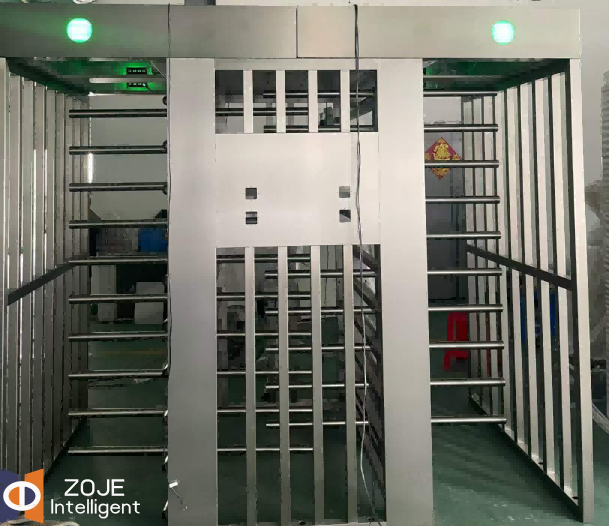
A construction site is not a polished lobby. It is a temporary, exposed perimeter where hundreds of workers come and go through a single controlled point, often before sunrise and after dark. The gate has to survive that environment for years without a technician on call. A swing gate with an acrylic wing would crack under the impact of a toolbox carried at hip height. A flap gate's folding wings would jam with dust and sand. A tripod turnstile is easy to climb over when the site is unattended. The full-height turnstile removes those failure modes by design: the cabinet and the rotating cage are both stainless steel, the passage is sealed top to bottom, and there is no point to climb over or duck under.
The height is the single most important specification. At 2250 millimeters, the rotating cage reaches well above shoulder level, and the bars run from near the floor to the top of the cabinet. A person cannot crawl underneath, and climbing over requires a deliberate effort that the anti-tailgating and anti-reverse functions make practically impossible. On a construction site where perimeter fencing is temporary and sometimes incomplete, that physical certainty matters more than any camera or alarm. A camera records a breach after it happens. A full-height turnstile prevents it in the first place. ZOJE engineers the cage so that a second person cannot slip through after the first, which is the difference between a gate that records a problem and one that stops it.
On a full-height turnstile ordered for outdoor duty, the drive choice matters as much as the cabinet. The drive choice on this order is the semi-automatic solenoid version, which suits a remote site better than a fully motorized unit. When a worker presents a card or a code, the solenoid unlocks the cage for one rotation, and the worker pushes it through by hand. ZOJE selected the solenoid drive for this Australian order because there is no motor to burn out, no gearbox to seize up with dust, and no software that needs rebooting after a power cut. In an emergency, the fail-safe mechanism releases the cage so it can be pushed freely, which is a requirement on any work site. The unit accepts AC110-230V power, which means it runs off the site's temporary electrical supply without a dedicated transformer.
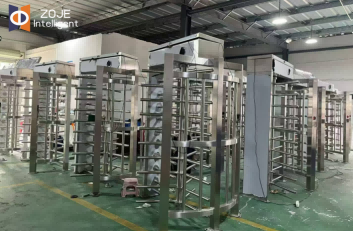
The Australian environment is part of the specification. Coastal and inland construction sites see UV exposure, humidity, and occasional rain, and the Z2001 carries an IP67 rating with an operating range from minus 30 to plus 80 degrees Celsius. The cabinet is 304 stainless steel as standard, with 316 stainless steel available for sites close to salt water. ZOJE specified 304 for this order, with the thicker 1.5-millimeter panel option, because the site is inland and the thicker skin resists dents from equipment traffic better than a thin cabinet would.
The full-height turnstile integrates with the site's access control system, and the integration on a remote site is deliberately simple. ZOJE configures each lane to read a card or a PIN code, log the passage, and send the record back to a central site system. Fingerprint or face recognition can be added, but most construction clients stick with cards because they survive being clipped to a high-visibility vest through a full shift. The bidirectional direction means the same lane handles workers arriving in the morning and leaving at the end of the day, without reconfiguration. This is why the full-height turnstile remains the standard choice for remote work sites.
The order of 200 units is not a single installation. It is a rollout across multiple site entrances, temporary accommodation blocks, and material checkpoints on a large project, which is why consistency between units matters. Every full-height turnstile on the order comes off the same production line, runs through the same cycle test before packing, and carries the same two-year warranty. ZOJE packs each unit in a seaworthy plywood crate for the ocean freight to Australia, and the installation hardware and spare parts are shipped alongside the first container so the site team does not wait for a second delivery when it is time to bolt the gates down.
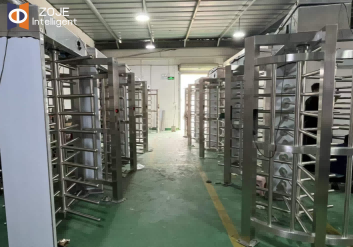
The value of a full-height turnstile on a construction site is not that it looks modern. It is that it does not need looking after. It stands in the weather, it lets one worker through at a time, it blocks anyone who does not have a card, and it keeps running without a daily check. For a project manager who has enough to manage without thinking about the pedestrian gate, that hands-off reliability is the whole point.
ZOJE has been shipping full-height turnstiles to outdoor and perimeter projects for years, and the Australian construction order is the latest batch. The Z2001 in this shipment is the standard 120-degree model with a single channel per cabinet, the solenoid drive, and the 600-millimeter passage. Operators who run sites in similar climates can specify the same configuration, with the option to widen the passage to 900 millimeters for wheelchair or material cart access.