Why Do Banks and Airport VIP Lounges Choose a Sliding Turnstile
Most people choose a pedestrian turnstile based on what they have seen in other buildings, not on what the traffic and security requirements actually need. An office lobby puts in a swing gate because the supplier had one on show. A metro station puts in a flap gate because it handles the high-speed pedestrian flow of peak-hour commuters. A construction site or an outdoor perimeter ends up with a full-height turnstile because it stops people from climbing over or tailgating through an unattended location. The gap in that lineup is the sliding turnstile, and it exists because a lot of entrances need something between a swing gate and a full-height barrier — tighter than a swing, more comfortable than a flap, and better looking than a full-height unit.
The mechanical difference is the first thing to understand. A swing turnstile pivots a door on a hinge, so the door moves through an arc as it opens and closes. A flap turnstile folds a pair of acrylic wings back into the cabinet. ZOJE's sliding turnstile moves its door straight sideways, parallel to the cabinet, until the door parks against the side of the lane. That horizontal motion changes how the gate behaves. There is no swinging arc to watch, no folding wing that can be pushed, and the door itself covers the full height of the passage when closed.
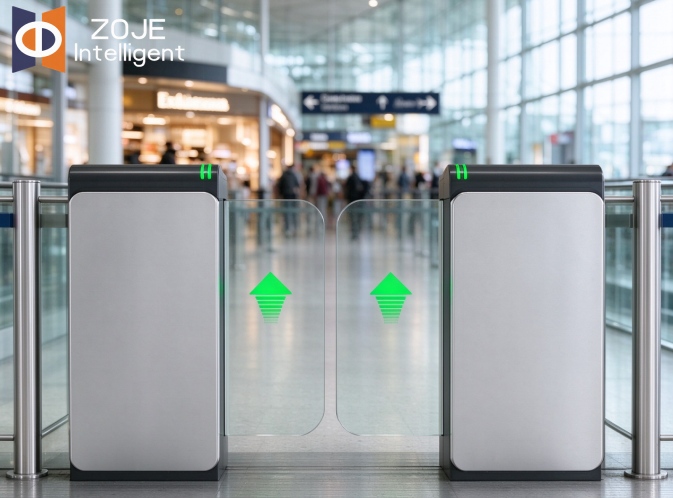
That closed coverage is the main advantage. A swing gate door is usually a panel around a meter tall, and a determined person can climb over or duck under it. A flap gate's wings fold away quickly, which makes it fast but leaves a gap between the top of the wing and the ceiling. The door on the unit reaches 1050 millimeters, and because it slides across the full width of the lane, the passage is physically blocked when the gate is closed. Pair that with the optional tailgating sensor and the intrusion alarm, and a second person who tries to follow someone through a closed lane triggers an alert and holds the door shut.
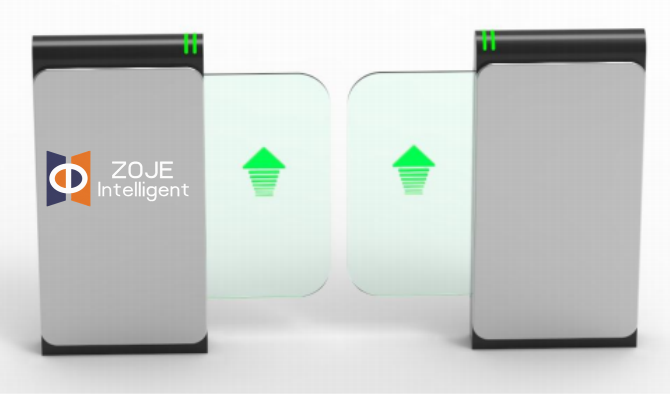
The anti-tailgating logic is where the sliding turnstile earns its place in banks, government buildings, and airport VIP corridors. A swing gate can be pushed open if the motor stalls, because the door is on a hinge and a determined shoulder will move it. The sliding door moves on a guided linear track, and the motor holds it against a direct push. The anti-reverse and wrong-way detection functions also close the door if someone tries to enter through the exit lane. These are not add-on features on the sliding turnstile; they are built into the control board as standard.
Speed does not suffer because the door slides. The sliding turnstile unlocks in 0.2 seconds, and ZOJE rates the throughput at 35 to 40 people per minute per lane, which matches a standard swing gate. The door travels a short distance to the side of the cabinet, so the opening cycle is quick even at full width. For a building that runs morning rush hour, the difference between 35 and 40 people per minute is the difference between a queue that clears and a queue that backs up into the lobby.
The PB106 cabinet is 650 millimeters long, 150 millimeters wide, and 1050 millimeters high, which is slimmer than most swing gate cabinets. The door material is acrylic as standard, with tempered glass as an option. The standard channel width is 600 millimeters, and it can be widened to 1000 millimeters for wheelchair access, luggage, or a baggage-handling lane. ZOJE builds the cabinet from 304 stainless steel as standard, with 316 stainless steel for coastal or corrosive environments, and the IP67 rating means the unit works in outdoor canopies and semi-exposed entrances where a normal indoor gate would not hold up.
The motor choice matters more on a sliding turnstile than on a swing gate, because the door moves linearly and any binding in the track shows up as noise or a stalled cycle. The PB106 uses a DC brushless motor as standard, with a servo motor option for higher-frequency sites. Two motors can be mounted in a single cabinet, which lets a project build a multi-lane line without doubling the number of control boxes. The MTBF rating is 10 million cycles, which is the number ZOJE specifies after bench testing, not a marketing figure.
Safety is handled three ways on the sliding turnstile: a physical contact edge, an infrared light curtain, and a mechanical drop-away structure. If the door touches someone while closing, the infrared beam detects the obstruction first, the physical edge backs it up, and the mechanical structure lets the door move away if both sensors somehow miss. ZOJE wires the fail-safe so the door opens automatically through the battery backup in a power failure, which keeps the exit clear during a fire alarm or a mains outage.
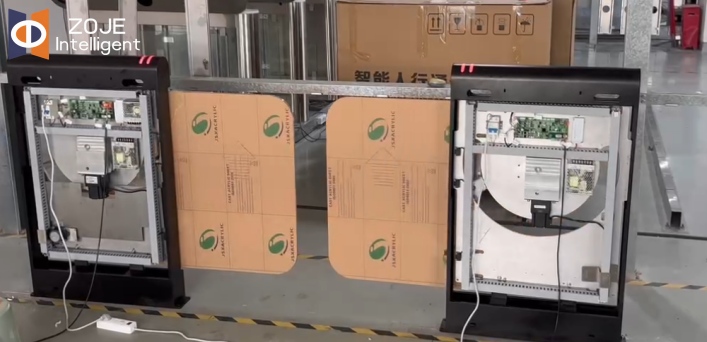
Integration is the same as any modern turnstile. The sliding turnstile accepts face recognition terminals, fingerprint readers, IC and ID cards, RFID tags, barcode scanners, and ESD readers over a standard external interface. It communicates over RS485 or TCP/IP, so it drops into an existing access control network without a proprietary protocol. ZOJE mounts an LED arrow on top of each cabinet, showing green for open and red for closed, which removes the need for a separate sign at the lane.
For a project that has already ruled out a full-height turnstile because it looks like a prison gate, and ruled out a swing gate because the security team needs better anti-tailgating, the sliding turnstile is the piece that fits. It is slim, it is fast, it blocks the lane when closed, and it looks like a premium entrance rather than a barrier. ZOJE supplies the PB106 as a standard model with the option to widen the channel, upgrade the door to tempered glass, or switch to a servo drive for heavy-use lobbies.