Why Are Parking Operators Switching to Self-Service Auto Payment Kiosks
Running a parking facility comes down to a simple equation that every operator knows: every minute a driver spends waiting to pay is a minute the facility is not making money, and every staffed toll booth is a recurring cost that never sleeps. For decades, the answer to both problems was the same — hire more staff, build more booths. At ZOJE, we believe the smarter answer is to remove the human from the payment loop entirely. The self-service auto payment kiosk is not a convenience add-on for modern parking facilities. It is the most direct way we know to cut operating costs and speed up the exit lane at the same time.
Let us put the numbers on the table. A conventional parking entrance staffs its payment booths with two to four people per shift, and those staff members cover the facility around the clock. On top of wages, the operator pays for training, scheduling, uniforms, and the management overhead that comes with supervising a team at every gate. None of that cost produces a single extra transaction. It only exists because someone has to sit in the booth and take the payment.
The same logic applies on the driver's side. In peak hours, the queue at a manual booth stretches, and the average wait time runs three to five minutes. Drivers who are already late do not enjoy that, and neither do the operators who lose their repeat business. When we show parking operators the comparison between a staffed lane and a self-service lane, the conversation usually ends the same way: the self-service lane has no staff on duty and an average wait time under thirty seconds.
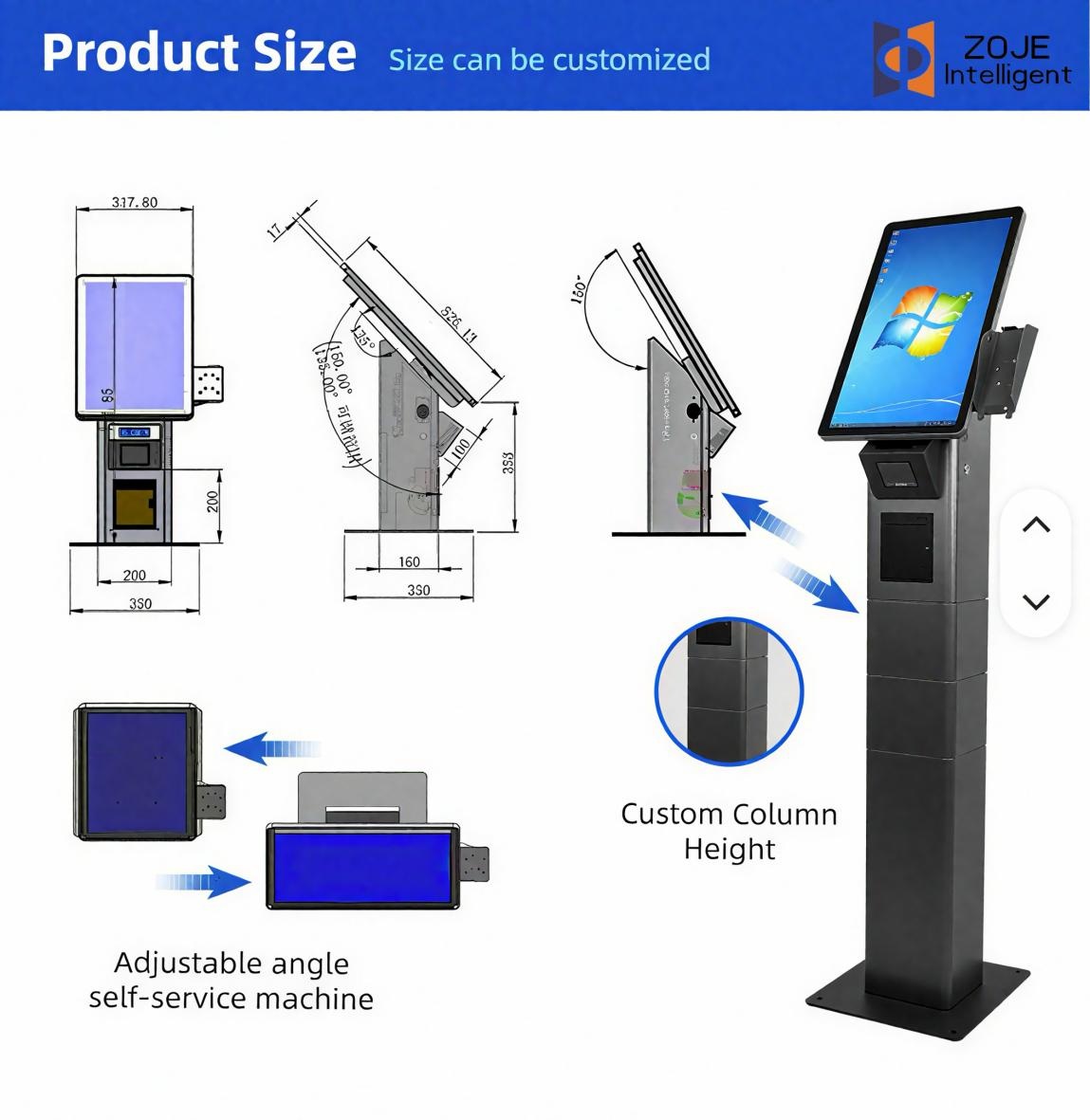
The ZOJE-P304 is a floor-standing self-service auto payment kiosk designed for cashless payment in parking facilities. The heart of the unit is a 27-inch full HD display with 10-point capacitive touch, running at 1920 by 1080 resolution. The screen is large enough for a driver to read the parking fee and complete the transaction without leaning out of the window or hunting for buttons.
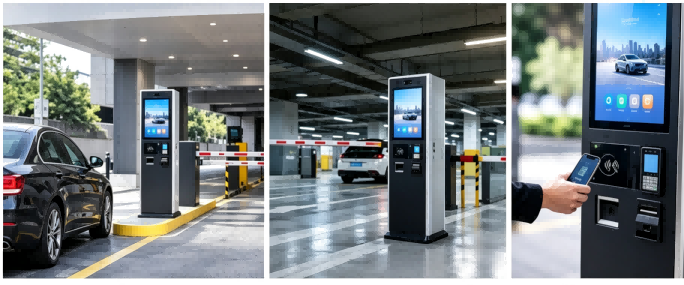
The self-service auto payment kiosk supports three payment paths. It accepts POS card payments, so drivers with bank cards can pay directly at the kiosk. It accepts QR code payments, which is the fastest-growing payment method in most markets. And it supports license plate-based payment processing, where the system looks up the vehicle by its plate and settles the parking record automatically. All three paths run through the same cashless workflow, which means there is no cash in the machine for staff to count and no cash in the booth for anyone to steal. For a facility that operates late at night, that security argument is as important as the efficiency one.
The unit is built to work around the clock. The enclosure uses first-class electrolysis plate and cold-rolled steel, and the components are selected for continuous duty. It runs on standard AC power from 110 to 240 volts, so it drops into any existing electrical supply without a transformer.
A self-service auto payment kiosk is a computer with a cash register attached, and ZOJE specifies this unit like one. The processor is available in three tiers: an RK3566 quad-core for standard installations, and Intel Core i3 or i5 options for facilities that run heavy local applications or need extra processing headroom. The operating system can be Android, Windows 7/8/10, or Linux, which matters because many parking operators standardize on one platform for their whole estate. The base memory is 4 gigabytes and can be customized for larger deployments.
The optional modules are where the self-service auto payment kiosk adapts to the site. A barcode printer can issue payment receipts or validation tickets. A barcode reader and QR code scanner handle paper tickets and phone-based codes. A camera can be added for driver verification or security recording, and a POS solution module extends the unit to handle card-present transactions from a full bank terminal. The screen content, voice prompts, and peripheral configuration are all customizable, so the same kiosk can present a shopping mall brand in one location and a hospital brand in the next.
The biggest difference between this self-service auto payment kiosk and an older standalone pay station is what happens after it is installed. At ZOJE, this machine integrates with a cloud-based management platform that gives the operator real-time monitoring of every kiosk. A fault triggers an alert before a driver reports it. A software update is pushed remotely instead of sending a technician to each unit with a USB stick. Logs are collected centrally, so an operator can see which machine is underperforming, which payment method is most used, and where the queues form.
For a parking network with machines across multiple sites, this changes the staffing model a second time. The operator no longer needs a maintenance crew driving between locations to check on units. The platform tells them exactly which machine needs attention and why. Remote upgrades and centralized management do not just reduce operating costs — they change what the parking management team does all day.
The self-service auto payment kiosk is a natural fit for any facility where drivers expect speed and operators need to control costs. Shopping centers use them in the walkway between the parking area and the mall, so drivers pay on the way in rather than queuing at the exit barrier. Airports and transportation hubs use them at the edge of the terminal, where the traffic is constant and the space for a toll booth is limited. Hospitals use them near the entrance so patients and visitors do not stand in line while someone is waiting to be seen. Office parks, mixed-use developments, supermarkets, and restaurants all use the same unit to keep their parking revenue flowing without adding headcount.
ZOJE's advantage in this market is that we already manufacture the rest of the parking system. The payment kiosk connects to the same platform as our parking barriers, our ANPR cameras, and our access control gates, so a facility can run entry, exit, and payment as one coordinated system rather than three disconnected products. That integration is exactly what a modern parking operation needs.
Every self-service auto payment kiosk that leaves the ZOJE factory goes through a burn-in test before it ships, and the product carries a two-year warranty. We also keep spare parts in stock for units that are years out of warranty, which matters for operators who run their kiosks around the clock and cannot afford a machine sitting idle waiting for a part.
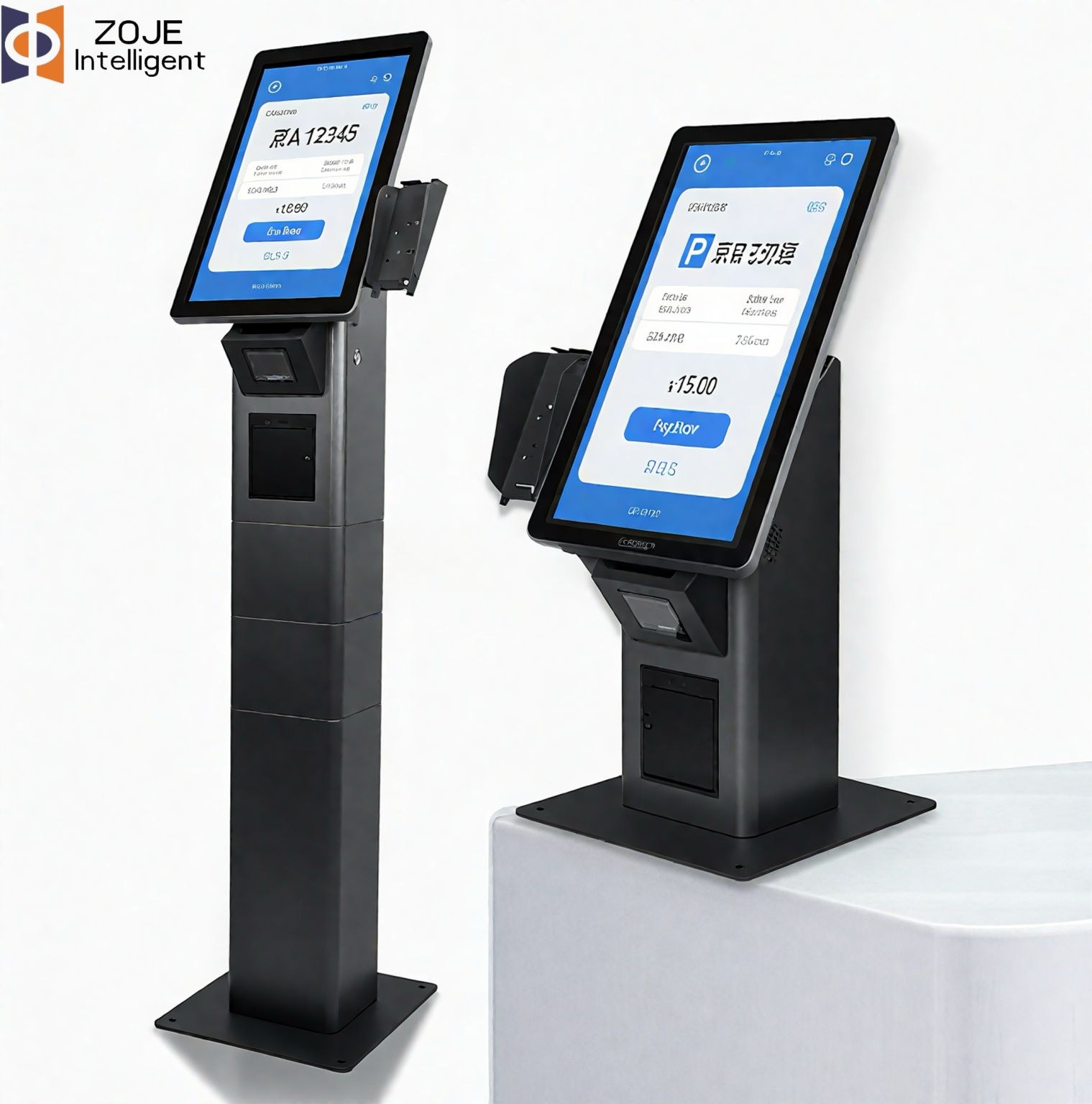
Customization is a standard part of the service. The screen content, branding, voice prompts, payment modules, and even the enclosure finish can be matched to the operator's requirements. We have supplied machines with custom payment integrations, special receipt formats, and site-specific software configurations for parking networks in several countries.
If you are operating a parking facility and you are still staffing toll booths, the numbers are worth a look. A self-service auto payment kiosk removes the queue, removes the cash, and removes the payroll line from your expense report. ZOJE's sales team can help you work out how many kiosks your site needs, where to place them, and how to integrate them with the equipment you already run. We can also arrange a demonstration unit so your operations team can see the machine working before you commit.