How Does Face Recognition Change a Turnstile Gate at the Office Lobby
A card proves that someone holds a credential. It does not prove who is holding it. In an office building, that gap is the whole access control problem: a card lent to a friend, a card copied at a reader, a card held open for the person behind, and the lobby has admitted someone who was never verified. Face recognition closes that gap because the credential and the person are the same object, and that is why the turnstile gate at the lobby entrance has moved from a card reader to a camera with a liveness check.
The pattern repeats across buildings that still run on cards and simple barriers. Cards are lost, borrowed, and cloned, so a stranger holding one walks in without being questioned. Staff arrive in a compressed window before nine o'clock, and a slow lane turns the lobby into a queue that reception has to manage on top of its own work. Visitors sign a paper book that nobody reads again, so the record exists but cannot be searched when a tenant asks who came up last Tuesday. Attendance, access control, and visitor management usually run on three separate systems, which means three sets of data and an administrator who reconciles them by hand at the end of the month. And an old barrier with a scratched reader does not match a lobby that the building owner has just finished renovating, which is a marketing problem as much as a security one.
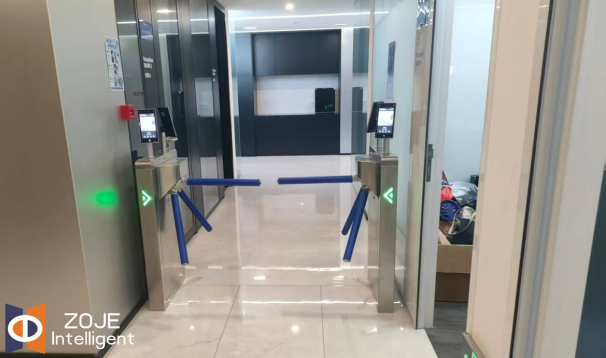
Face recognition at the turnstile gate addresses all of those at once, because one verification event can serve several purposes. A dual-lens terminal with liveness detection checks that the face in front of it belongs to a living person, which rejects a printed photo or a video replay. It reads in strong backlight, low light, and the mixed lighting of a glass lobby, takes about 0.3 seconds to match, and releases the barrier within milliseconds. The face library scales to tens of thousands of enrolled people, which covers a large tenant mix or a multi-building portfolio. The lane also runs offline: if the network drops, the terminal keeps matching against the local library, the barrier keeps working, and the records sync when the connection returns. For a lobby that cannot stop operating because a switch failed, that behavior is the difference between a queue at the door and a normal morning. ZOJE specifies the terminal for the lighting the lobby actually has, because a camera rated for an indoor office fails when the entrance is twelve meters of glass.
The building does not have to standardize on face alone. A turnstile gate lane can switch verification modes by group: face for staff who have enrolled, IC card for the employees who prefer the habit, QR code for a visitor pass issued on a phone, NFC for a mobile credential, a PIN for a contractor, and a document check for a supplier who arrives without anything else. ZOJE configures the lane with a unified external interface, so the reader set is a project decision rather than a factory decision, and a building can start with face plus card and add a mode later without replacing the barrier.
Attendance is the second use of the same event. Every passage through the turnstile gate writes a record with the person, the lane, and the time, and that record is the attendance data. Nothing needs to be punched separately, and the administrator exports the report from the platform rather than rebuilding it in a spreadsheet. For a multi-tenant building the records are separated by tenant, and for a single-company headquarters they feed the HR system directly. The saving is not only the clock-in machine; it is the second reconciliation that used to sit between the access system and the payroll month. ZOJE sets the export in the format the tenant's HR system already accepts, so the report is a download rather than a rebuild.
Visitor management is where the lobby feels the change most directly. A tenant or an employee raises a request online, the request is approved, and the system issues a temporary face permission to the visitor for the booked window. The visitor arrives, walks to the turnstile gate, and passes without stopping at the reception desk. The permission expires on its own at the end of the window, so nobody has to remember to cancel it, and the record keeps the passage photo and the in and out times, which can be queried later. Reception stops being a registration counter and goes back to being a reception desk, and the paper book disappears. ZOJE links the visitor workflow to the lane permission, so a booking approved at nine in the morning is usable at the barrier at ten without a manual update at the desk.
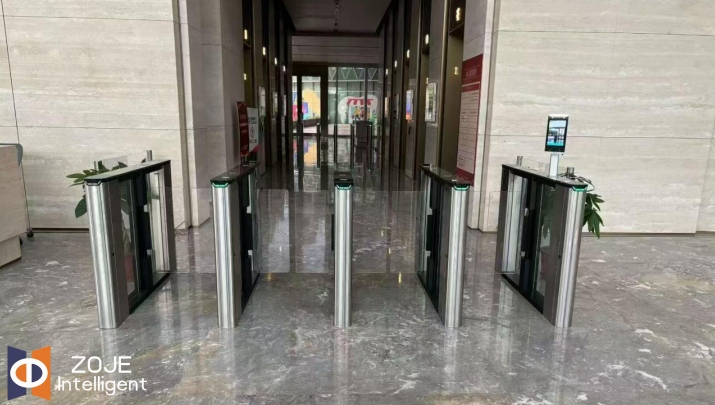
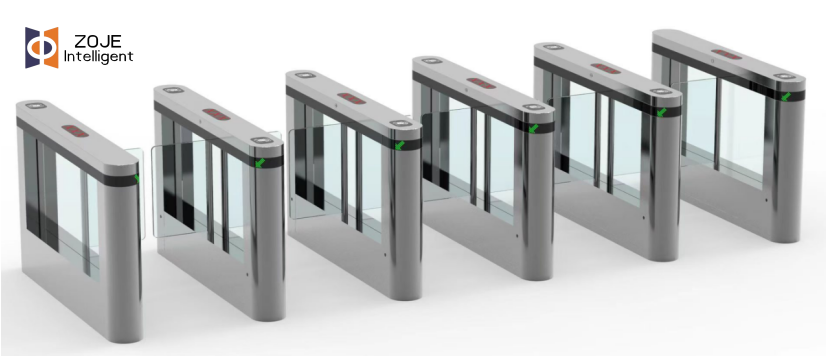
The physical side matters as much as the software in a building where the lobby is part of the brand. Three barrier types cover most office projects: the flap turnstile gate with retracting glass wings, the swing barrier with standing panels, and the speed gate with slim cabinets and fast doors. All three carry infrared tailgating detection and anti-clamp protection, so a second person cannot follow a verified one into the building, and the lane stops closing on someone who is still inside. The cabinet finish is a specification item rather than a default: brushed or mirror stainless steel, a powder-coated color to match the lobby palette, and a glass or acrylic wing that suits the interior. ZOJE's BST500 speed gate, at 1400 by 146 to 203 by 1000 millimeters with a 600-millimeter passage and a 900-millimeter option, is the model that most Grade A lobbies end up choosing, because the cabinet is narrow, the doors are quiet, and the glass matches the entrance design.
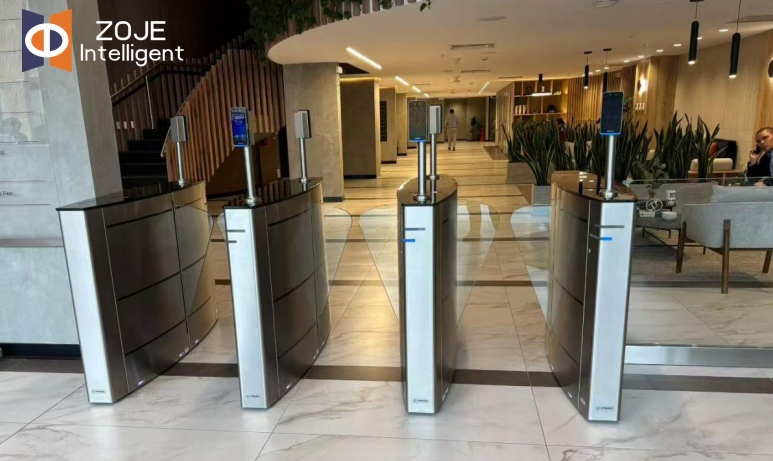
The platform behind the turnstile gate lanes is what turns separate devices into one system. An administrator adds or removes a face permission remotely, sets the allowed hours, and assigns zones, so a cleaner's credential can open the lobby lane but not the finance floor, and a tenant's staff can reach their own floor but not the plant room. The same platform connects to the building automation, the lift control, and the CCTV, which is what makes one face enough for the lobby barrier, the lift call, and the floor door. ZOJE runs that integration against the protocols the building already uses rather than asking the property manager to replace three systems. A building that runs those three systems separately is running three versions of the same permission list, and they drift apart within a month.
Selection in an office project follows the lobby rather than a product ranking. A Grade A tower or a corporate headquarters usually takes the speed gate, because the barrier has to be quiet, precise, and visually consistent with a premium entrance. A standard office building, a small enterprise, or a multi-tenant block is better served by a swing or flap turnstile gate, which costs less, offers a comfortable passage width, and handles the daily staff and visitor mix without ceremony. A large complex with many floors and frequent visitors combines several lanes with a self-service visitor terminal, so the morning peak splits across channels instead of concentrating at one desk. And an older building that is being upgraded can often keep its existing barriers and add face terminals to them, which avoids the cost of a full replacement and shortens the work to a few nights.
One technical detail decides whether the installation works in practice. An indoor lobby needs a terminal with starlight wide dynamic range, and a lobby with a glass wall and direct sun across the lane needs a dual-lens wide dynamic unit with liveness detection, because a camera that saturates in the morning sun will fail every face at the worst hour of the day. That is a selection question, not an installation question, and it should be settled before the lane is ordered.
ZOJE supports the whole path from survey to service on a turnstile gate project: site measurement, lane layout, hardware customization, integration with the tenant and HR systems, installation and commissioning, staff training, and after-sales maintenance. The package is configured for the property manager, the integrator, or the corporate client, and it can carry visitor management, attendance, and lift control as one scope. Single buildings and multi-building portfolios are both routine, with the lane count and the reader mix confirmed against the morning peak rather than the average day.