How to Select Pedestrian Turnstile Motors: A Data-Driven Comparison of Lifespan, Speed, and Stability
When purchasing pedestrian turnstiles, many customers initially focus on appearance, materials, or identification methods (RFID cards, facial recognition, QR codes).
However, in actual project operation, the fundamental factor that truly determines equipment stability, durability, and user experience lies at a deeper level:
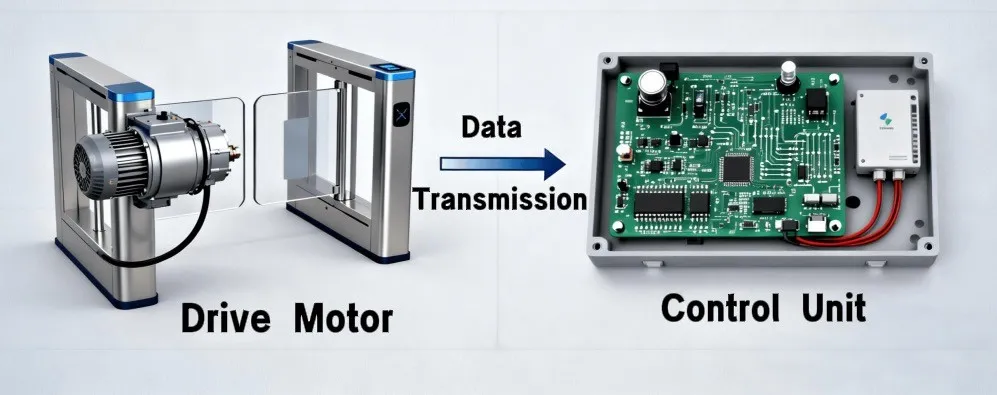
From an engineering and application perspective, this article combines technical specifications with field experience to help you understand the differences between motor solutions and how to select the optimal one for your project.
1. Why the Motor Defines Turnstile Stability?
Based on operational and maintenance data from numerous pedestrian gate projects, statistics reveal that:
a) Approximately 60%–70% of equipment failures originate within the motion system.
b) Over 50% of these issues are directly related to the motor and its drive components. This indicates that the motor system is the primary factor determining a turnstile’s service life, stability, and overall throughput experience.
It is also common to encounter the following scenarios in field applications:
c) Initial operation is smooth and normal.
d) After 1–2 years of use, the equipment begins to experience stuttering, abnormal noise, and frequent failures.
When tracing the root cause, most of these issues are directly linked to the motor type and its control methodology.
2. Core Data Comparison of Different Motor Solutions
Currently, pedestrian turnstiles on the market primarily utilize three motor solutions: Brushed Motors, Brushless DC Motors (BLDC), and Servo Motors. The following is a comparison of typical engineering parameters (industry standard ranges:
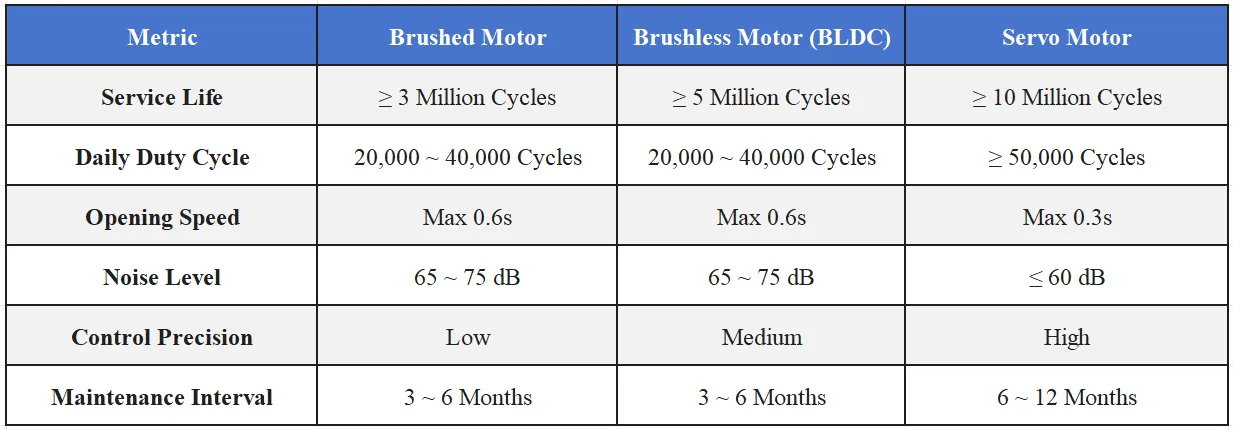
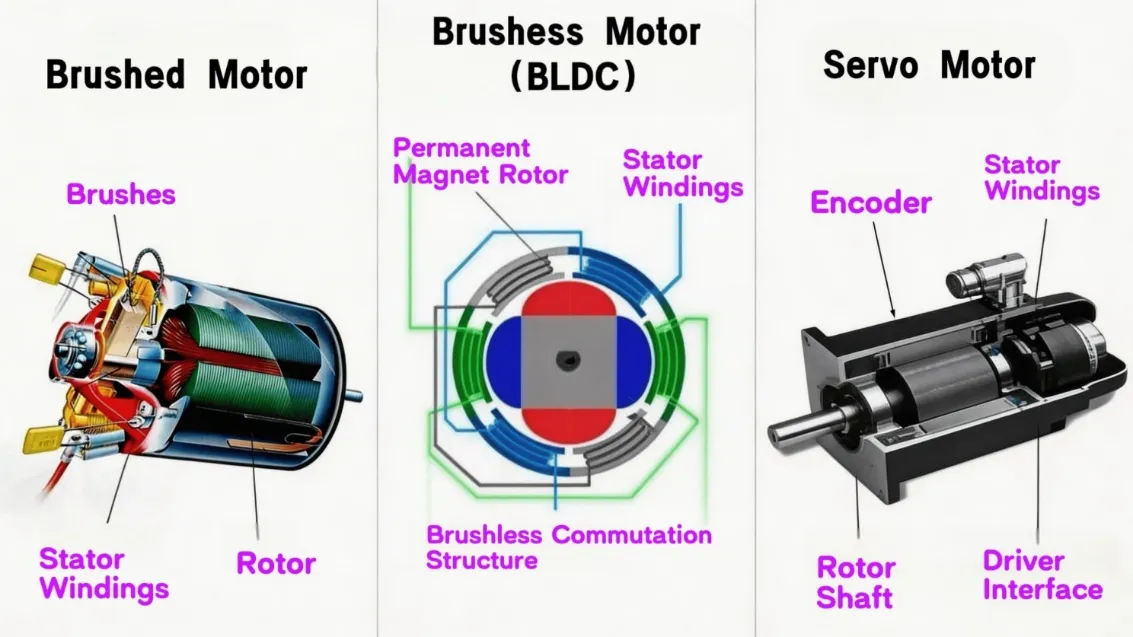
In actual project selection, we typically prioritize motor solutions based on throughput frequency and service life rather than simply comparing equipment costs. Compared to traditional brushed motors, brushless motors (BLDC) can increase lifespan by 2–3 times, while servo motors offer further advancements in speed, precision, and safety.
3. Throughput Efficiency: Quantifiable Improvement in User Experience
Many clients express a desire for "smoother turnstiles," but "smoothness" is actually a quantifiable metric.
a) Opening Speed (Direct Impact on Queuing)
Brushed Motor: Approx. 0.6s
Brushless Motor (BLDC): Approx. 0.6s
Servo Motor: As fast as 0.3s
In office buildings and industrial park projects (with daily traffic exceeding 20,000+), the following throughput rates are clearly observable:
Brushed Motor: Approx. 25–35 persons/minute
Brushless Motor (BLDC): Approx. 25–35 persons/minute
Servo Motor: 35+ persons/minute
The difference is immediately felt in whether a lobby experiences queuing or
congestion.
b) Operational Smoothness (Eliminating "Stutter")
The core factor is the capability for acceleration and deceleration control:
Brushed Motor: No control → Harsh start/stop cycles.
Brushless Motor (BLDC): Basic motion profiles → Generally smooth.
Servo Motor: S-curve acceleration/deceleration → Virtually impact-free.
In high-frequency transit scenarios, these differences are continuously amplified, directly impacting the overall user experience.
c) Noise Control (Environmental Impact)
Commercial office environments typically require: Noise Level ≤ 50 dB
Brushed Motor: 60+ dB (Noticeable noise).
Brushless Motor (BLDC): Generally compliant with standards.
Servo Motor: Near-silent operation.
4. Safety Capabilities: The Critical Impact of Motor Variation
a) Anti-Pinch Response Speed
b) Brushed Motor: 100–300ms
c) Brushless Motor (BLDC): 50–100ms
d) Servo Motor: 10–50ms
e) The shorter the response time, the higher the safety level—a difference that becomes critical in high-density traffic scenarios.
Summary: How to Avoid Common Pitfalls in Selection?
If you take away only one thing, let it be this: The real difference between turnstiles lies not in their exterior aesthetics, but in their motors and control systems.
To be more specific:
a) Low-Frequency Scenarios: Brushed motors are a viable option.
b) Standard Projects: Brushless (BLDC) motors are the preferred choice.
c) High-End Projects: Servo motors are highly recommended.
Bottom Line: Choosing the wrong motor leads to ongoing maintenance costs; choosing the right motor turns your equipment into a long-term, stable asset. If you are currently in the process of project selection, I recommend focusing on the following key areas: Motor Type (Whether it is Brushless or Servo), Control Method (Whether it features acceleration and deceleration control), Proven Track Record (Availability of actual project operational data). In specific projects, tailoring the motor and control scheme to actual traffic requirements is often far more effective than simply comparing technical specifications.