How Can Parking Lots Eliminate the Loopholes of License Plate Sharing and Fee Evasion?
In the past, many parking lots relied on IC or ID cards. These physical cards were extremely easy to duplicate and inexpensive to produce; consequently, the practice of using "one card for multiple vehicles" became an open secret. Later, license plate recognition (LPR) cameras gradually entered the mainstream. However, early LPR camera algorithms lacked sufficient accuracy; when encountering dirty, obstructed, or visually similar license plates (such as "0" and "D"), they were prone to misidentification. This created opportunities for vehicles using cloned plates to slip through. Furthermore, if multiple parking systems operated in isolation without data interoperability, a license plate deemed "legitimate" within one facility's records could become an unverified "loophole" when entering another.
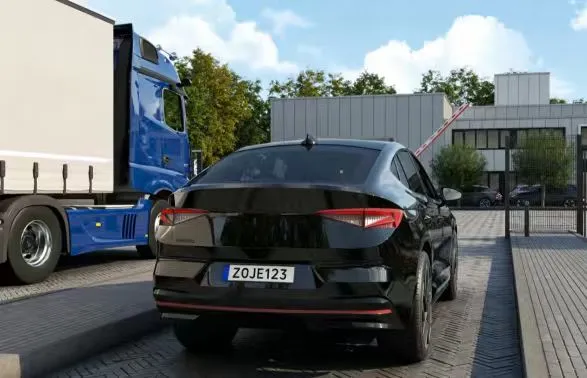
If a parking barrier gate operates solely by raising the barrier arm the moment a license plate is recognized by the camera, a vehicle with a valid plate could be correctly identified, allowing a second vehicle to tailgate closely behind it into the lot—a scenario the system would struggle to detect. Alternatively, when temporary visitors exit, if the system merely records entry times but lacks the capability to forcibly intercept unpaid vehicles, security personnel are often left helpless when faced with drivers attempting to crash through the barrier, forced to watch idly as they evade payment.
Many legacy systems lack deep integration with modern payment platforms, resulting in cumbersome payment processes. Before exiting, drivers must scan a QR code, manually enter their license plate number, and complete the payment. If network connectivity is poor, long queues can quickly form behind them. Frustrated drivers may then choose to simply crash through the barrier to escape. Moreover, management personnel are unable to monitor "abnormal vehicles"—such as "zombie cars" that have been parked for extended periods without payment—in real-time; instead, they must rely on manual patrols, an inefficient and labor-intensive approach.
As you can see, the failure to prevent these issues is not due to lax management, but rather because the technical architecture of the systems themselves contains too many inherent loopholes that can be exploited.
Now, ZOJE’s professional parking management system offers not merely a single standalone function, but a comprehensive, interconnected system of preventive measures.
1. "Vehicle Profiling": High-Precision Recognition and Comprehensive Data Traceability
Modern license plate recognition cameras are embedded with advanced AI algorithms. In standard operating environments, their comprehensive recognition rate—covering conditions such as dirty plates, missing plates, and more—approaches 100%. Through multi-frame fusion and feature analysis technologies, these systems can identify not only alphanumeric characters but also specific vehicle attributes such as make, model, and color, thereby generating a detailed "vehicle profile." The mature application of this AI-driven visual recognition technology has significantly increased the difficulty of duplicating license plates (plate cloning). Whenever the system detects a license plate number, it simultaneously cross-references the vehicle's make and color; if there is a mismatch, the vehicle is immediately flagged as an anomaly.
To address the issue of "tailgating" to evade fees, specialized video analysis algorithms have now been implemented. License plate recognition cameras can precisely determine the distance and movement trajectories of leading and trailing vehicles. If a trailing vehicle fails to present a valid license plate and follows too closely behind the vehicle ahead, the barrier gate will remain open; simultaneously, the system will trigger an alarm and capture high-resolution images of the trailing vehicle to preserve as evidence.
2. Frictionless Payment + Anomaly Alerts + Intelligent Interception
By ensuring the payment experience is as seamless and effortless as possible, we eliminate both the opportunity and the incentive for vehicle owners to evade fees.
We have crafted a fully "frictionless payment" experience for vehicle owners. Upon their initial use, owners simply need to link their license plate and enable password-free payments via WeChat or Alipay. Upon entry, the system automatically recognizes the vehicle and raises the gate; upon exit, it automatically deducts the fee and raises the gate—the entire process takes approximately two seconds. For management, all traffic and transaction records are fully digitized and automated, ensuring that every financial flow is transparent and traceable. This fundamentally eliminates the loopholes associated with cash collection and the "gray areas" prone to human manipulation.
But what about the rare instances where a vehicle owner simply refuses to pay or attempts to maliciously force their way through the gate? When the system identifies a vehicle as "unpaid" or "blacklisted," it can coordinate with the barrier gate to execute a "refusal of release" command. Concurrently, on-site equipment issues an audible warning, while an alert immediately pops up on the "cloud-based console" within the guard booth or on the management staff's handheld terminals, displaying the vehicle's details and captured images. Security personnel can then quickly approach to handle the situation; with irrefutable evidence in hand, they can resolve the matter with full justification and authority.
3. Cloud-Based Operations & a Data-Driven Early Warning Network
The status of all parking facility equipment (cameras, barrier gates), traffic flow logs, and transaction data are uploaded to a cloud-based platform in real-time.
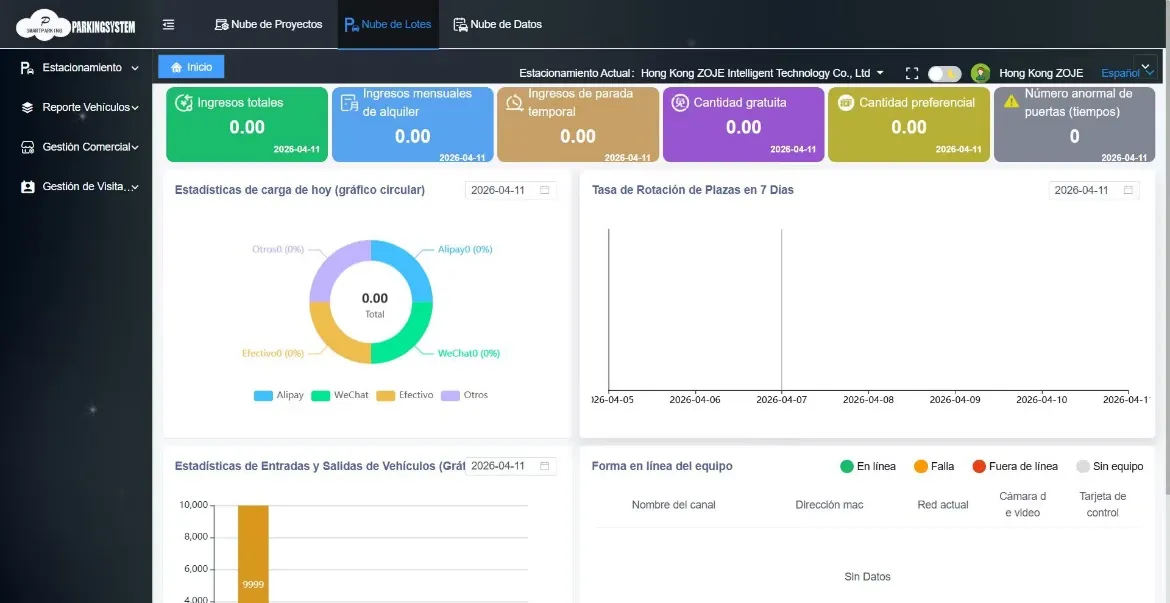
Through a desktop management portal or a mobile app, administrators can maintain a comprehensive overview of operations anytime, anywhere. Real-time traffic flow at each entrance and exit, parking space utilization rates, vehicle dwell times, lists of high-priority vehicles requiring special attention—all these critical metrics are fully at their fingertips. Should any parking facility encounter anomalies—such as unauthorized barrier breaches, equipment malfunctions, or requests for assistance from vehicle owners—the central control center can immediately conduct remote visual inspections via video intercom and multi-screen surveillance. Subsequently, operators can either remotely lift the barrier directly or issue instructions for on-site personnel to handle the situation. Furthermore, through data-driven analytics dashboards, the system can deeply mine insights into traffic flow patterns and user profiles. This provides a scientific basis for operational decisions—such as peak-and-off-peak pricing strategies and parking space allocation—thereby enabling the parking facility to continuously evolve from a "cost center" into a "value center."
Preventing the unauthorized reuse of access cards and combating fee evasion no longer relies on manual oversight; instead, it depends on three key pillars: a high-precision, fully networked AI LPR camera recognition system; a seamless, automated payment closed-loop; and an intelligent, proactive cloud-based management "brain." By using these three criteria as the benchmark for system selection, one can naturally identify the ideal parking solution—one that simplifies management operations while effectively plugging potential loopholes.