How to Select the Motor for a Pedestrian Access Turnstile Based on the Project Scenario?
When selecting turnstiles for pedestrian access points in office buildings, subway stations, campuses, and similar venues, most customers tend to focus primarily on stylish aesthetics, robust materials, or convenient and reliable authentication methods (such as facial recognition or QR code scanning). However, a deeper—and ultimately more critical—factor often reveals its decisive importance only after the equipment has been in operation for an extended period: the "heart" and "brain" of the turnstile—the motor and its control system.
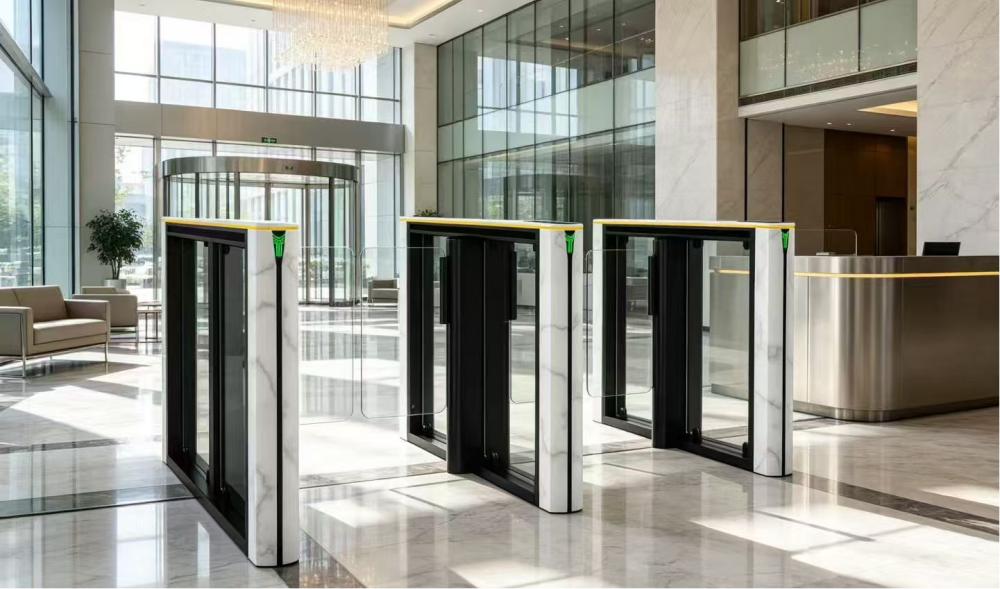
1. Why is the Motor the Lifeline of Turnstile Stability?
Engineering maintenance data indicates that as much as 60% to 70% of all malfunctions in access control turnstiles originate within the motion system, and of these issues, more than half are directly attributable to the motor drive. Many projects function flawlessly during their initial rollout, yet after just one or two years of operation, they begin to suffer from stalling, abnormal noises, and frequent breakdowns; the root cause of most such issues can be traced back to improper motor selection. Consequently, the quality of the motor system directly determines both the total lifecycle cost of the turnstile and the overall user experience.
2. A Comparison of the Three Mainstream Motor Technologies
Currently, access control turnstiles on the market primarily utilize three distinct motor solutions: brushed motors, brushless motors, and servo motors. The performance disparities among these three technologies dictate entirely different levels of application suitability and operational capability.
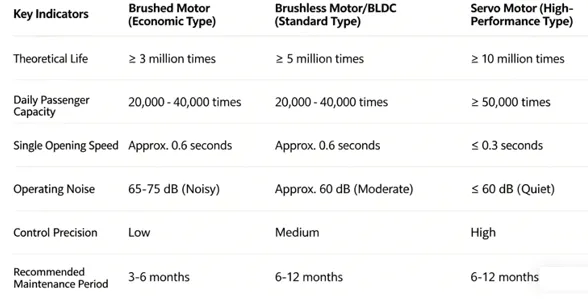
Compared to traditional brushed motors, the lifespan of brushless motors is increased by two to three times; servo motors, meanwhile, represent a comprehensive leap forward in terms of speed, precision, quiet operation, and service life. When selecting a motor, one should base the decision on long-term calculations regarding anticipated traffic volume and projected service life, rather than merely comparing the initial purchase price of the equipment.
3. Real-World Experiential Differences Driven by Performance Disparities
a) Throughput Efficiency: Speed Determines Whether Queues Form
Even minute differences in gate opening speeds are drastically amplified during peak traffic hours. With a minimum opening speed of 0.3 seconds—compared to the 0.6 seconds typical of traditional solutions—servo motors allow for the passage of over 10 additional people per minute. This effectively alleviates queuing pressure during the morning and evening rush hours in office buildings and subway stations.
b) Operational Quality: Smoothness and Silence Enhance the Environmental Experience
Smoothness: Brushed motors exhibit abrupt starts and stops, while brushless motors operate with basic stability. Servo motors, however, utilize S-curve acceleration and deceleration control to achieve nearly shock-free, fluid operation, ensuring a consistently smooth experience without any sense of stuttering, even after prolonged use.
Silence: In noise-sensitive environments—such as offices, commercial complexes, and high-end venues—the near-silent performance of servo motors is critical; conversely, the continuous noise generated by brushed motors can become a significant source of environmental disturbance.
c) Safety Assurance: Reliable Protection When It Matters Most
Anti-Pinch Response: Servo motors boast the fastest response times (10–50 ms)—far superior to those of brushless motors (50–100 ms) and brushed motors (100–300 ms)—thereby maximizing safety protection during periods of heavy pedestrian traffic.
Anti-Collision Capability: Servo motors feature dynamic torque control functionality. When confronted with forced gate breaches or external physical obstructions, they can precisely adjust their force in real-time (with an error margin of less than 5%). This capability not only effectively prevents unauthorized entry but also safeguards the equipment against mechanical damage. In contrast, brushed motors are highly susceptible to damage under such circumstances.
4. Selection by Application Scenario: Finding the Ideal Solution for You
a) Temporary/Low-Frequency Scenarios (e.g., construction sites, temporary events):
Core Requirements: Cost-priority; fulfillment of basic functional needs.
Recommended Solution: Brushed Motors. For projects with limited budgets and short operational lifecycles, this offers the best value for cost.
b) Standard/Durable Scenarios (e.g., factories, schools, residential complexes)
Core Requirements: Stability and reliability; extended maintenance intervals; long-term durability.
Recommended Solution: Brushless DC (BLDC) Motors. Striking the optimal balance between lifespan, stability, and cost, this serves as the "gold standard" for most standard projects.
c) High-Frequency/High-Efficiency Scenarios (e.g., office buildings, subway stations, commercial complexes)
Core Requirements: High throughput efficiency; superior user experience; consistently low long-term failure rates.
Recommended Solution: Brushless DC Motors or Servo Motors. For high-traffic hubs such as subway stations, Servo Motors are the preferred choice for ensuring maximum efficiency.
d) Premium Quality Scenarios (e.g., high-end office buildings, financial institutions, airport VIP lounges)
Core Requirements: Ultra-quiet operation; exceptionally smooth performance; highest-level security standards; alignment with premium brand image.
Recommended Solution: Servo Motors. Their exceptional quietness, operational smoothness, and safety features meet the most rigorous quality standards.
5. The Core Principle for Avoiding Selection Pitfalls
The true difference in value among turnstiles lies not in their visible exterior, but in their invisible components: the motor and the control system. A Guide to Selection Decisions:
a) Define Requirements: Begin by assessing the project's average daily pedestrian flow, projected service life, and environmental constraints (such as noise standards).
b) Focus on the Core: When reviewing technical specifications, prioritize the motor type (specifically, whether it is brushless or servo-driven) and the control mechanism (specifically, whether it features intelligent acceleration and deceleration curve control).
c) Calculate for the Long Term: Factor potential downtime due to malfunctions, maintenance costs, and the impact of a compromised user experience into the Total Cost of Ownership. Opting for a more reliable motor solution at the outset often proves to be a more economically sound asset investment in the long run.
Selecting the right motor for your access turnstiles is akin to purchasing an "insurance policy" for the project's smooth and uninterrupted operation over the long term. During the tendering or procurement process, it is imperative to scrutinize and evaluate this aspect as a core technical requirement.