What Are the Benefits of Iris Recognition in Pedestrian Access Turnstiles?
Iris recognition technology, as a high-precision and secure biometric technology, has been widely used in access control management. Pedestrian access control turnstiles are a very common and important device in modern life, helping administrators effectively control the entry and exit of personnel to and from facilities. Combining iris recognition technology with pedestrian access control turnstiles can improve the security and ease of use of access control systems, making access control management smarter and more efficient.

Iris recognition technology can accurately identify a person's identity by extracting and comparing the texture and color characteristics of the human iris. Its application in pedestrian access control turnstiles can avoid the drawbacks of traditional methods, such as lost cards and password leaks. Furthermore, iris recognition technology allows for contactless identification; identification is performed simply by blinking.
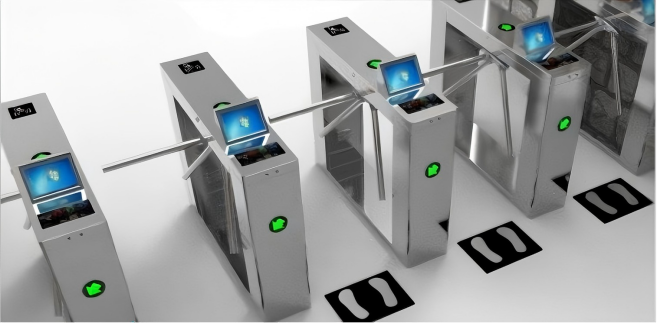
As an access control device, pedestrian access control turnstiles help administrators effectively manage the entry and exit of personnel to and from facilities, thus fulfilling the objective of access control management. When combined with iris recognition technology, efficient and accurate personnel identification and access control can be achieved, thereby improving the efficiency and security of access management. In practice, pedestrian access turnstiles can also be integrated with other devices, such as access control systems and security monitoring systems, to achieve comprehensive and intelligent access management. With the rapid development of emerging technologies such as artificial intelligence, cloud computing, and big data, iris recognition systems can be deeply integrated with backend data platforms to achieve real-time analysis and monitoring throughout the entire data chain. For example, in corporate parks or large office buildings, data linking can enable features such as employee route analysis, access frequency analysis, and alerts for abnormal behavior, upgrading the security system from a traditional "prevention mode" to an intelligent "predictive mode." This proactive security system provides a higher level of security for modern scenarios.
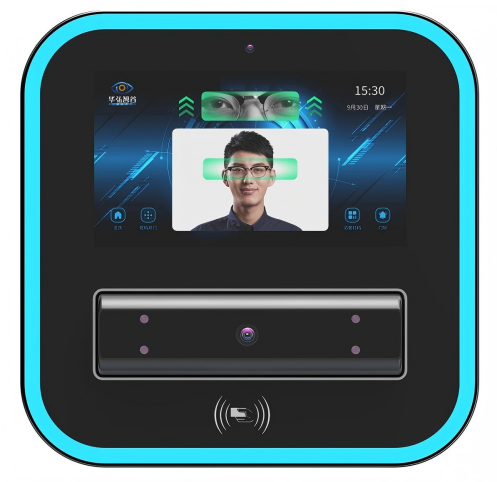
Compared to facial recognition, which can be affected by light, angle, and occlusion (such as masks, hats, hairstyles, etc.), iris recognition offers greater stability and consistency. In low-light or even completely dark environments, iris recognition systems can function accurately without additional lighting. This allows the system to maintain efficient and accurate identity verification capabilities in underground passages, nighttime locations, warehouses, epidemic prevention environments, and even some military installations. For specialized personnel, such as medical staff, laboratory personnel, and cleanroom operators, who often need to wear protective equipment like masks, helmets, or goggles, facial recognition can be problematic. However, iris recognition technology easily overcomes these obstacles, offering greater convenience. From a security perspective, iris recognition is virtually impossible to falsify. The iris structure remains stable throughout a person's life and is difficult to obtain, effectively preventing identity fraud even in high-security environments. Furthermore, iris feature storage can employ encryption algorithms, existing in a database as template data. Even if the data is leaked, it is impossible to reconstruct a person's biometric characteristics, ensuring user privacy and security.
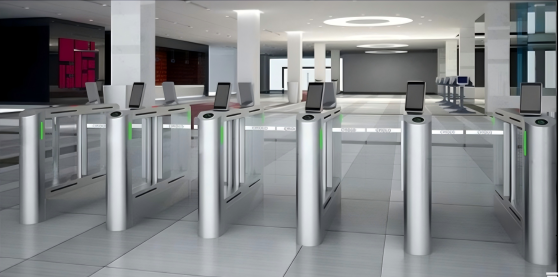
The deep integration of iris recognition technology into pedestrian access controls not only improves security and convenience but also promotes the continuous development of access control management toward computerization, intelligence, and systematization. With technological maturity and cost reduction, iris recognition is believed to play a more significant role in various fields, providing crucial support for modern urban management and safe construction.