What Features Does Smart Turnstiles With Dynamic Face Recognition Offer?
A facial recognition turnstile integrates a facial recognition module into the basic hardware. By collecting the visitor's facial information and processing it with a specific algorithm, it determines access permissions. People don't need to stop or wait to pass through. As long as the person is within a certain recognition range, whether walking or standing, the facial recognition system will automatically recognize them. In other words, if a pedestrian passes by naturally, the camera will capture and collect information, issue the corresponding instructions, and the turnstile will open automatically after dynamic facial recognition.

The structure of the turnstile’s facial recognition system consists of three parts:
1. Face Acquisition and ID Card Generation: This part primarily collects facial and identity information from photos or the turnstile's camera, models and stores this information, and uses it as the basis for creating ID cards.
2. Facial Recognition and Turnstile Activation: This part collects facial information from passersby via the camera and compares it to the information in the database. If the recognition result is correct, the turnstile opens, allowing the pedestrian to pass. If the database does not contain the person's facial information, the turnstile can be opened by swiping a card.
3. Facial Recognition Results Statistics and Large Screen Display: This part stores the facial recognition results, provides statistical analysis functions, and displays the facial recognition status and query results on a large screen.
Features of the Smart Turnstiles with Dynamic Facial Recognition:
1. Access Mode Switching: Entry and exit directions can be independently configured as [Controlled Access] / [Free Access] / [No Access].
2. Voice Prompt Function: A voice prompt function has been added to the turnstile's entry and exit directions to remind users of the access information and status.
3. Facial Recognition Function: In standby mode, when a pedestrian enters the facial recognition area, the system automatically recognizes their facial features. If the user is legitimate, the turnstile opens.

4. Automatic Return Function: When the turnstile receives a legitimate opening signal in standby mode, it opens. The door will automatically return to the closed state under the following conditions:
(1) Within the permitted access time, personnel are detected passing in the designated direction.
(2) Outside the permitted access time, personnel are not detected passing.
5. Automatic Reset Function: If the gate is opened due to human intervention, it will automatically close upon removal.
6. Automatic Adjustment Function: When the turnstile experiences mechanical wear and requires readjustment, it can be automatically adjusted via the control board, ensuring accuracy and convenience.
7. Passage Request Memory Function: When two or more valid passage signals are issued simultaneously (including signals in the same and opposite directions), the system will remember all passage requests and complete each action in turn. The maximum memory capacity is 255 requests.
8. Passage Indication Function:
(1) Passage Direction Indicator: Installed on the top of the chassis, it indicates the valid passage direction of the turnstile.
(2) Channel Status Indicator: Installed on the side of the chassis, it indicates whether the turnstile can open the gate upon receiving a valid opening signal.
9. Wer-On Self-Test Function: After power is connected, the system performs a routine self-test and issues alarms, intelligently detecting key hardware and functions to quickly identify potential hazards. Power-Off Opening Function: Thanks to a unique, industry-leading mechanical structure, the system automatically unlocks the turnstile when power is cut off. It can be opened manually to facilitate evacuation, meeting fire safety requirements.
10. Anti-Crush Function:
(1) Infrared Anti-Crush: Several pairs of infrared detectors are installed near the area where the turnstile moves (anti-crush zone). Upon detecting a person or object in the anti-crush zone, the turnstile stops automatically; it will only resume when the person or object leaves the anti-crush zone.
(2) Mechanical Anti-Crush: The turnstile stops automatically upon encountering an obstacle during its movement; The impact force during door movement remains within a safe range.
(3) Anti-crushing current detection: When the turnstile encounters an obstacle during its movement, the system detects an abnormal change in current and controls the motor to stop its rotation or reverse direction, preventing the turnstile from crushing pedestrians.
11. Excessive force feedback control function: When the door is locked, it can withstand impact forces within a safe range. If the force exceeds the safe range, the door can be slowly pushed open to protect the mechanism and pedestrians. After human intervention ceases, the turnstile automatically resets.
12. Emergency escape function: An emergency escape control device is configured to automatically open the turnstile to facilitate the evacuation of people.
13. Intelligent link alarm: Unauthorized access events can be linked to other alarm and monitoring devices, such as access control systems and video management systems.
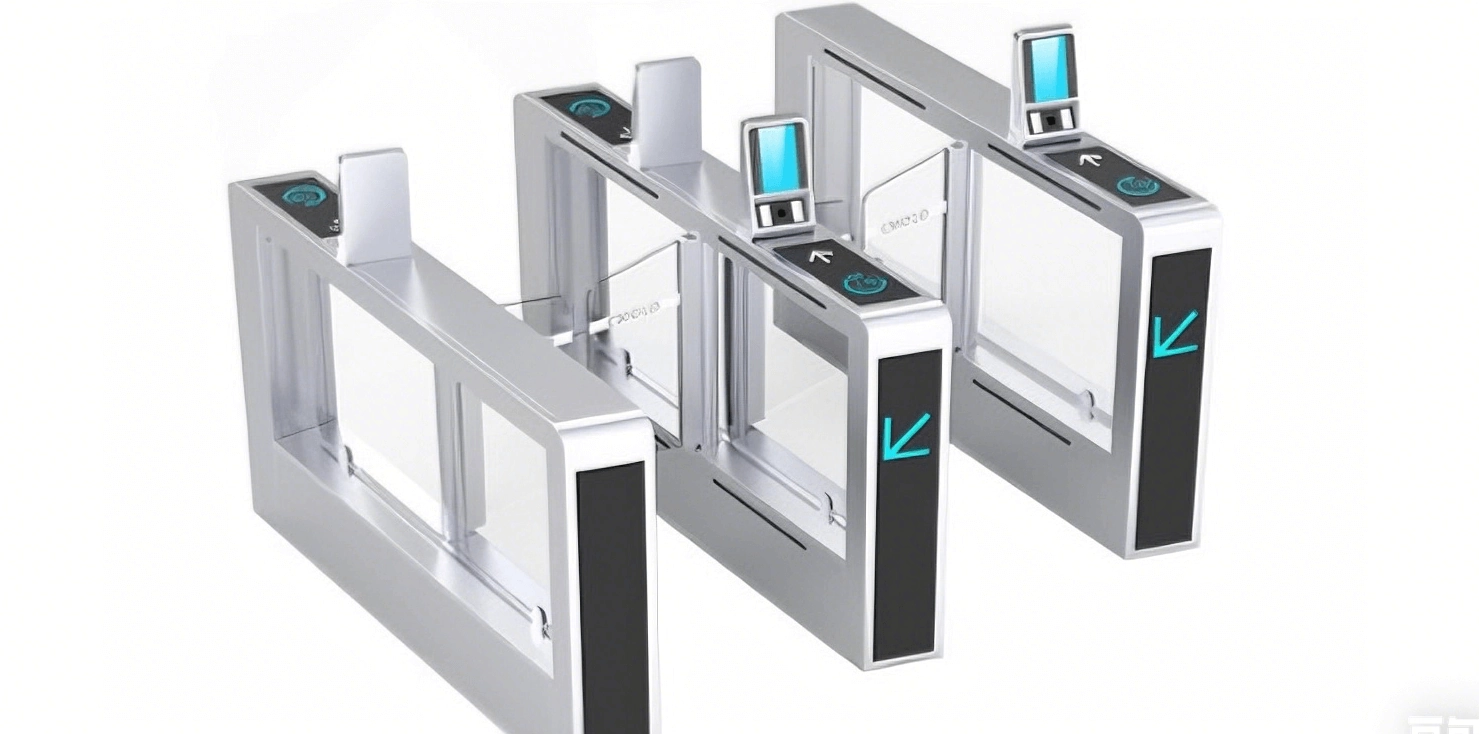
Facial recognition turnstiles are primarily used in train stations, airports, and subway ticket control. They effectively ensure smooth passage for passengers with valid tickets, improving efficiency and reducing costs. Furthermore, their applications are even broader, including residential communities, office buildings, university residences, libraries, government offices, factories, construction sites, technology parks, and access points to computer rooms and laboratories. These systems combine facial recognition with smart card turnstiles, achieving not only efficient and controllable access but also an aesthetically pleasing and practical interior and exterior design.