Why Choose Panel-Style Barrier Gates for Smart Vehicle Access Management?
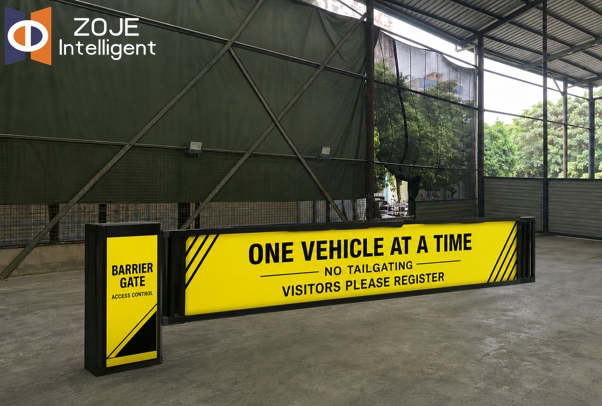
Our team has completed factory testing of a wide-panel Barrier Gate developed for entrances that need both vehicle control and highly visible information. Instead of using a narrow straight boom, this model carries a large rectangular panel across the lane. The surface can display traffic instructions, visitor procedures, safety reminders or commercial graphics.
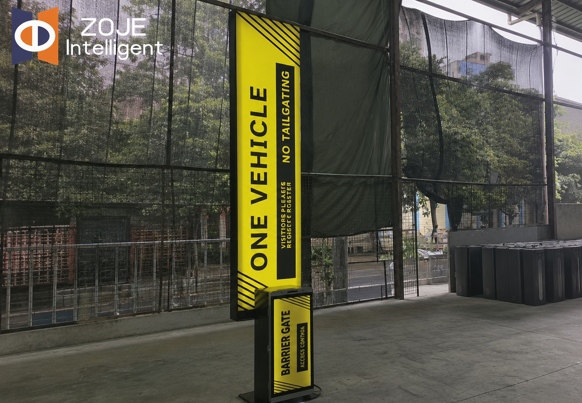
The tested units use a bold yellow-and-black finish with messages such as “One Vehicle, One Barrier,” “No Tailgating,” and “Visitor Vehicles Please Register First.” The purpose of the design is not decoration alone. It places important information directly in front of the approaching driver while the lane is closed. In this way, the Barrier Gate becomes both an access device and a visible information point at the entrance.
Turning the boom into a communication surface
Signs are often installed beside an entrance, on a wall or near a security booth. Drivers may overlook them while watching traffic, looking for a card reader or trying to enter the correct lane. A panel-style Barrier Gate puts the message at the natural stopping point, where it is much harder to miss.
This format can be useful in residential compounds, factories, logistics centers, schools, hospitals, office parks, temporary event areas and paid parking facilities. A factory can instruct outside drivers to register before entering. A residential community can remind visitors not to follow an authorized vehicle through the gate. A shopping center can display parking rules, operating hours or promotional information.
ZOJE can prepare the panel graphics according to the customer's required wording and visual style. Strong contrast is recommended when the message concerns traffic or safety. A hotel or office campus may prefer a cleaner branded design, while a warehouse or construction entrance may need bright warning colors that remain visible from a distance.
What a wide-panel design changes
The larger surface is the main advantage of the product, but it also changes the engineering requirements. Compared with a thin boom, a broad panel catches more wind and places different loads on the moving mechanism. The arm length, panel structure, cabinet drive and installation foundation therefore need to be considered together.
During testing, the ZOJE production team checks the complete opening and closing cycle. The panel should leave the vertical position smoothly, move downward in a controlled way and settle correctly when the lane is closed. When it rises again, it should reach the intended open position without excessive movement or instability.
Repeated operation can reveal details that are not obvious in a single cycle. Technicians listen for abnormal noise, inspect the mounting points and compare the final positions of the arm. They also check the printed surface, edges and cabinet finish. Because an advertising-style Barrier Gate occupies a large part of the entrance, alignment and appearance are particularly noticeable.
Suitable applications in the current market
Vehicle entrances are increasingly automated, but clear communication remains necessary. ANPR cameras, RFID readers, QR scanners and parking software can decide whether a vehicle is authorized. They do not always tell a first-time visitor where to stop, whether registration is required or why the lane remains closed.
A panel boom helps fill that gap. It can present a short instruction while the Barrier Gate physically prevents entry. This combination is useful at mixed-traffic sites where employees, residents, contractors, delivery drivers and visitors use the same entrance under different rules.
In commercial parking, the panel can carry payment guidance or branding. At an industrial facility, it may display safety instructions or direct trucks to a registration point. At a school or hospital, it can tell drivers to slow down or wait for security clearance. ZOJE recommends keeping the wording brief so it can be read quickly from inside a vehicle.
Integration with vehicle access equipment
The wide panel changes the appearance of the gate, but the basic control principle remains familiar. An opening command may be provided by an ANPR camera, RFID reader, ticket system, intercom, guard station or remote controller. Once authorization is received, the Barrier Gate opens the lane and returns to the closed position according to the system logic.
License plate recognition is now commonly used at residential properties, office parks and car parks because regular users can enter without handling a card or ticket. RFID is still practical for staff vehicles, long-term tenants and fleet management. Visitor lanes may rely on intercom approval or temporary QR credentials. ZOJE confirms the appropriate connection method based on the customer's access-control arrangement.
Safety equipment must also be selected for the actual lane. Vehicle detectors, photocells or other protective inputs may be included depending on the required configuration. The recognition point, stopping line, gate position and safety detection area should work together. Software cannot compensate for a cabinet placed in a turning path or for an entrance that gives drivers too little room to stop.
Choosing the right site for a panel boom
Not every project should use this design. A fast exit lane with frequent cycles may be better served by a lightweight straight arm. A large panel is more suitable where visibility and information are important and where the environmental conditions allow it to operate safely.
Before accepting an order, ZOJE reviews the required opening width, expected daily cycles, local wind conditions, power supply, mounting foundation and access method. An exposed coastal entrance requires different consideration from a sheltered underground car park. The design must suit the location rather than simply look impressive in a product catalogue.
Installation and maintenance access are equally important. The foundation must support the cabinet securely, and technicians need enough space to inspect the drive system and adjust the arm. The printed surface should be cleaned with suitable materials so the information stays readable. If the customer later changes the message, the replacement graphic should fit the panel without affecting its balance or visibility. These planning steps help the Barrier Gate keep both its mechanical function and its communication value over time.
More than a standard parking arm
The advertising-panel model gives property managers a direct way to communicate with every driver who reaches the gate. It can reinforce entry rules, guide visitors and make the entrance easier to understand, while still carrying out the normal task of controlling vehicle movement.
For ZOJE, the correct product is the one that matches the real job at the site. Where speed and a light structure are the priority, a standard boom may be the right answer. Where the entrance needs a strong visual stop and a large message area, this Barrier Gate offers a practical alternative.
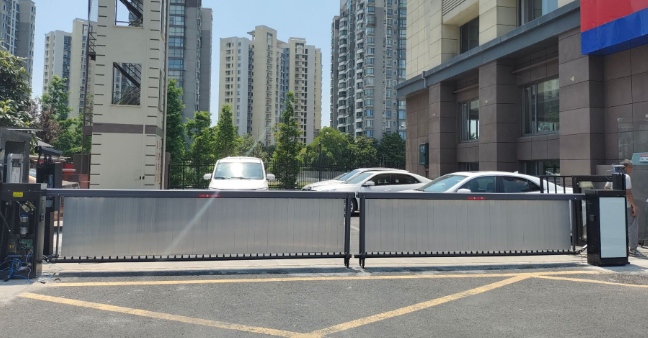
Factory testing confirms the movement, stopping positions and finished appearance before shipment. Careful site planning then connects the unit with the appropriate identification, control and safety equipment. When these elements are considered together, the result is a vehicle entrance that is clear, manageable and suited to daily use. The final Barrier Gate configuration can then be matched to the customer's traffic rules, graphics and access-control method.