What Are the Differences Between Fully Automatic and Semi-Automatic Rising Bollards?
Rising bollards—also known as retractable road posts, anti-ram bollards, hydraulic rising posts, or security barriers—are widely utilized in a diverse range of settings. These include urban traffic zones, military bases and the perimeters of critical government facilities, pedestrian streets, highway toll stations, airports, schools, banks, large private clubs, and parking lots. By regulating vehicular access, they effectively safeguard traffic flow while ensuring the security of key facilities and premises. So, what distinguishes the widely popular fully automatic rising bollards from their semi-automatic counterparts, and what are the respective advantages of each?

Semi-automatic rising bollards employ a hydraulic drive mechanism and require no external power supply; instead, their raising and lowering functions are controlled via a dedicated key. This design ensures simple operation and offers excellent economic practicality. Their primary advantage lies in their specialized nitrogen-hydraulic power unit, which generates powerful lifting force. Since they do not require an external electrical power source, installation is convenient, eliminating the need to lay down power cables or conduits. Compared to electric automatic rising bollards, they offer lower costs, and the use of a dedicated key system enhances security. Furthermore, they are easier to install and operate, exhibit a low failure rate, boast a long service life, and are capable of sustaining high-frequency operation over extended periods.
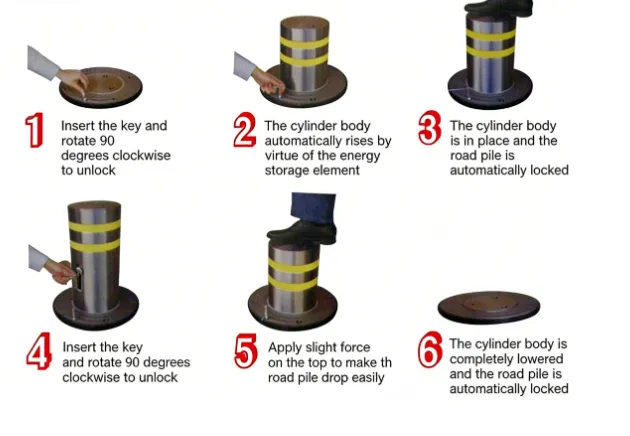
Semi-automatic bollards are typically deployed in locations where raising and lowering operations are infrequent, or in areas lacking on-site security personnel—such as along the perimeter railings of public squares—where temporary adjustability is required but frequent, repetitive movement is unnecessary. Fully automatic bollards, conversely, are controlled via remote or wired control units; they can be integrated with barrier gate systems, visitor management systems, and similar platforms, or operated independently. These systems boast exceptional practicality, reliability, and security. They are widely utilized across a diverse range of settings, including urban traffic management, military installations, the entrances and perimeters of critical government agencies, pedestrian streets, toll stations, airports, schools, and university campuses. By regulating vehicular access, these bollards effectively safeguard both the personnel and property within the protected areas, serving as a veritable "security shield."

A key reason why fully automatic bollards consistently garner positive reviews from consumers is that their core control units employ advanced multi-functional logic controllers. These controllers can be configured to execute a variety of operational modes, thereby satisfying the diverse functional requirements of different users. Furthermore, it is worth noting that the operational stroke of the fully automatic bollard—specifically the raising and lowering of the bollard head—is governed by an adjustable timing mechanism. This allows users to freely customize the lifting height based on specific on-site conditions and immediate needs, thereby optimizing energy efficiency. As fully automatic bollards operate on a hydraulic system, they are inherently eco-friendly and energy-efficient; their low power consumption translates into a reduced failure rate, lower maintenance costs, and a significantly extended service life. In the event of emergencies—such as a power outage—the bollards can be operated manually. By manually activating the emergency lowering mechanism, the bollard head retracts to create an open passage, allowing for the release of trapped vehicles; this manual override ensures stable and reliable operation even under critical circumstances. The lifting time for these bollards is measured in mere seconds; consequently, the operational speed of fully automatic bollards is substantially faster than that of their semi-automatic counterparts meeting equivalent standards.