What Constitutes the Core Architecture and Operational Modules of an Anti-Collision Swing Gate?
A two-way anti-collision swing gate mainly consists of a main-side gate device and a secondary-side gate device. The main-side gate device includes the gate housing, main control module, auxiliary control module, motor control module, interface display module, buzzer, inbound traffic indicator light, inbound card reader, infrared sensor receiver array, and main-side flapping gate structure. The secondary-side gate device includes the gate housing, outbound traffic indicator light, infrared sensor transmitter array, outbound card reader, and secondary-side flapping gate structure. The main-side and secondary-side gate devices of the two-way anti-collision swing gate are connected by a bridging cable.
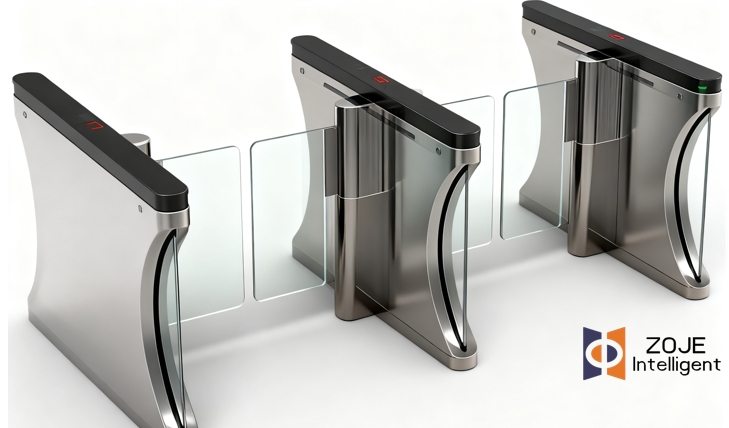
The main functional modules of the bidirectional swing gate include a sensor module, a main controller module, and a system communication module.
1. Main Controller Module: The main controller module of the bidirectional swing gate first receives pedestrian passage status data collected by the auxiliary control module, then judges pedestrian passage based on the passage recognition algorithm, and controls the operation of the indicator panels and buzzers based on the judgment result. In addition, it sends control command data to the motor control module via the CAN bus to control the status of the bidirectional anti-collision swing gate.
2. Auxiliary Control Module: This module is mainly responsible for the normal operation of the sensor detection module of the bidirectional anti-collision swing gate, realizing the synchronous transmission and reception of infrared signals to obtain passage status signals. It then converts the status signals into passage status data and transmits it to the main control module via the CAN bus.
3. Sensor Module: This module consists of a sensor transmitting array on the slave side and a sensor receiving array on the master side. It is responsible for detecting the pedestrian passage status within the bidirectional anti-collision swing gate channel. When there is an object between the transmitting and receiving sensors, it outputs a high level; otherwise, it outputs a low level.
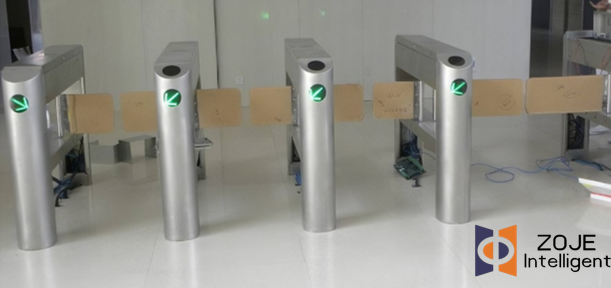
4. Sound and Light System Module: This module of the bidirectional anti-collision swing gate mainly consists of channel indicator lights, passage indicator lights, and alarm devices. Channel indicator lights are installed at both ends of the gate body to show whether pedestrian passage is permitted or whether the gate equipment is functioning properly. If authorized passage is permitted in this direction, it displays green; otherwise, it displays red. Passage indicator lights are installed on the top of the gate housing. When a pedestrian is authorized, the bidirectional anti-collision swing gate opens accordingly, and the passage indicator light for that direction changes from red to green, indicating that the pedestrian can pass through the gate normally. The alarm module is used to detect various unauthorized passages. The alarm device typically uses a high-decibel buzzer and can be set with different alarm modes as needed, such as continuous sounding or intermittent sounding, corresponding to different degrees of abnormality (such as tailgating, forced entry, reverse passage, etc.).
5. Motor and Mechanical Drive Module: This module receives commands from the main controller via the CAN bus and controls the opening and closing of the swing arm. The motor typically uses a servo motor or a geared DC motor, equipped with torque control and overload protection functions to achieve smooth and precise operation of the swing arm. When encountering resistance (such as pedestrian collisions or obstructions from foreign objects), the motor can automatically reverse or enter a slow-stop state, playing a role in physical collision prevention and injury protection, which is the core manifestation of the "collision prevention" function.
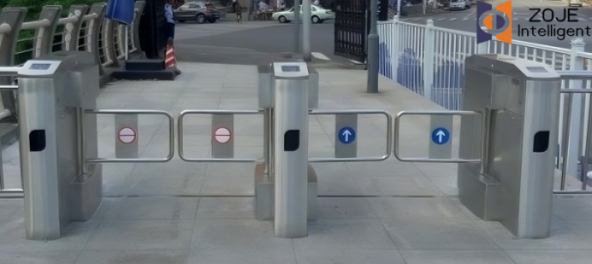
6. Communication and Integration Module: In addition to internal CAN bus communication, the swing gate typically provides standard external communication interfaces (such as RS485, TCP/IP, Wiegand protocol, etc.) to facilitate data exchange with upper-level access control systems, ticketing systems, or central management platforms. This module is responsible for receiving external authorization signals (such as card swipe, facial recognition, and QR code verification signals) and uploading the turnstile's real-time status (such as open/closed status, alarm information, and passage count) to the management system.
Through the precise coordination of the above modules, the bidirectional anti-collision swing gate achieves efficient management of passage permissions and effective protection of pedestrian safety. Its design not only emphasizes efficient passage logic judgment and rapid mechanical response but also stresses warning, protection, and flexible handling capabilities in cases of illegal passage or abnormal situations. Therefore, it is widely used in subways, airports, stadiums, office buildings, and other locations requiring high security and high passage efficiency. The entire system embodies the comprehensive application of mechatronics, intelligent detection, and networked management technologies.